


Enjoy Our Podcasts
SYNOPSIS:
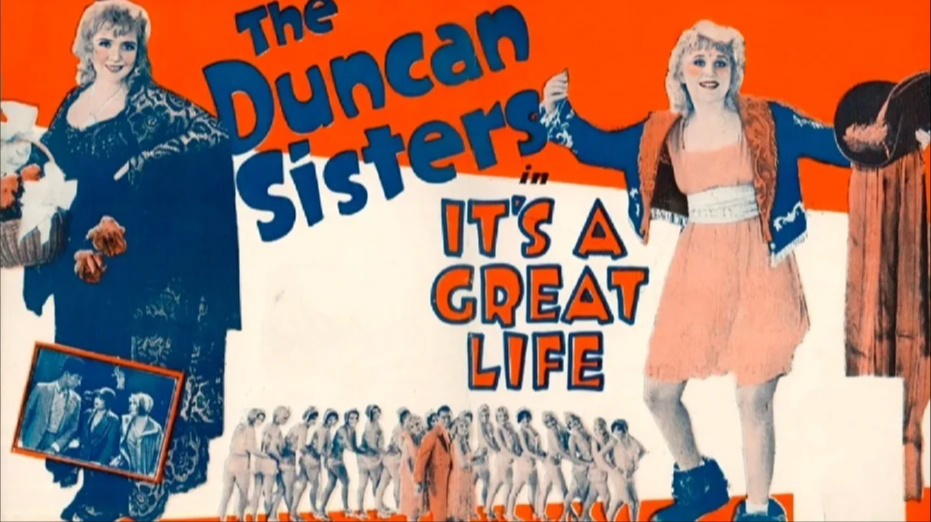
It’s a Great Life (1929) is an American musical comedy film directed by Sam Wood and starring the popular vaudeville duo Duncan Sisters—Rosetta Duncan and Vivian Duncan. Produced during the early transition to sound cinema, the film showcases the sisters’ signature blend of comedy, music, and heartfelt charm.
The story follows two sisters navigating life’s hardships with optimism and humor. Despite financial struggles and personal setbacks, they remain determined to improve their circumstances while maintaining their close bond. Their journey is filled with musical performances, comedic misadventures, and moments of emotional sincerity.
At its core, It’s a Great Life emphasizes resilience, family loyalty, and the power of maintaining a positive outlook even in difficult times. The title reflects the film’s central message—that happiness can be found through perseverance and companionship rather than material success.
PLOT (Spoiler Alert):
The film centers on the two sisters as they struggle to make ends meet while pursuing opportunities in entertainment and social advancement. Their contrasting personalities—one more grounded and the other more idealistic—create both conflict and comedy.
As they attempt to break into a better life, they encounter a variety of characters who either help or hinder their progress. Their journey includes stage performances, romantic entanglements, and moments of near success that are often undercut by bad luck or misunderstanding.
Throughout the story, their bond is tested by external pressures and differing ambitions. However, when circumstances reach a low point, the sisters reconcile and realize that their relationship is more valuable than any fleeting opportunity for fame or fortune.
The film concludes on an uplifting note, with the sisters reaffirming their partnership and embracing life with renewed optimism.
PRODUCTION:
It’s a Great Life (1929) was produced during Hollywood’s transition from silent films to sound, making it an early musical talkie. Directed by Sam Wood, the film capitalized on the popularity of the Duncan Sisters, who were well known for their Broadway success in Topsy and Eva.
The production emphasized musical numbers and performance-driven scenes, allowing the sisters to showcase their established stage talents. Like many early sound films, the technical approach was relatively static, with limited camera movement due to recording constraints.
The film was produced and distributed by Metro-Goldwyn-Mayer, one of the leading studios adapting quickly to sound-era filmmaking.
RELEASE:
The film was released in 1929 in the United States by Metro-Goldwyn-Mayer during the early wave of musical films that followed the success of The Jazz Singer.
While not as widely remembered today, It’s a Great Life was part of the industry’s push to integrate popular stage performers into cinema, helping bridge the gap between vaudeville, Broadway, and film.
CAST:
Rosetta Duncan as Casey Hogan
Vivian Duncan as Babe Hogan
Lawrence Gray as Jimmy Dean
Jed Prouty as Mr. David Parker
Benny Rubin as Benny Friedman
CREW:
Director: Sam Wood
Producer: Metro-Goldwyn-Mayer (studio production)
Production Company: Metro-Goldwyn-Mayer
Distributor: Metro-Goldwyn-Mayer
Country of Origin: United States
Release Year: 1929
Format: Black-and-white, early sound musical
TRIVIA:
The Duncan Sisters were among the early stage performers successfully brought into film during the transition to sound.
The film reflects Hollywood’s early experimentation with musical storytelling following the success of The Jazz Singer.
Director Sam Wood would later become known for major films like A Night at the Opera (1935) and Goodbye, Mr. Chips (1939).
Like many early sound films, It’s a Great Life is not widely circulated today and is considered relatively obscure.
The Duncan Sisters were best known for their stage success, particularly in Topsy and Eva, which influenced their on-screen performances.
All the singing by Rosetta Duncan, Vivian Duncan, and Lawrence Gray is live in this production. Nothing is pre-recorded.
Trade paper ads announced this film under the title of "Cotton and Silk."
Future star Ann Dvorak is easily spotted among the chorus dancers and is the featured dancer on the left in the 'Hoosier Hop" number.
After The Duncan Sisters proved unavailable for The Broadway Melody (1929), they were rushed into this film to cash in on the craze for musicals.
Two sequences, filmed in 2-strip Technicolor, totaling 1391 feet, occur in reels #2 (The Faulty Fashion Show) #10 (The Hoosier Hop and I'm Sailing on a Sunbeam).
Sheet music shown for songs from the movies Marianne (1929), The Hollywood Revue of 1929 (1929), The Broadway Melody (1929), The Divine Lady (1928).
Rosetta Duncan and Vivian Duncan were billed as The Duncan Sisters and were among the biggest Vaudeville stars of the 1910s and 20s.
The marriage license shows a date of 1921.
Jeane Wood's debut.
IMDB RATING: 5.9/10
OVERALL:
It’s a Great Life (1929) stands as an example of early Hollywood’s transition into sound filmmaking, blending vaudeville-style performance with emerging cinematic techniques. While modest in scale, it captures the spirit of optimism and resilience characteristic of late-1920s musical comedies and preserves the legacy of the Duncan Sisters during a pivotal moment in film history.
OUR MOVIE REVIEWERS SAY...

If you’re willing to meet It’s a Great Life on its own terms—as a product of early sound cinema—it’s surprisingly charming. Director Sam Wood understands exactly what he has in the Duncan Sisters: not subtle dramatic actresses, but energetic performers with impeccable timing and a genuine sisterly chemistry you simply can’t fake.

it’s not a great film by modern standards, but it’s an interesting one. Directed by Sam Wood, the movie reflects a moment when Hollywood was still figuring out how to use sound, and that uncertainty shows in its uneven pacing and structure.
The Duncan Sisters bring genuine chemistry and energy, which gives the film its strongest moments. However, the story itself feels thin, often resembling a series of stage routines rather than a fully developed narrative.

Let’s be honest—It’s a Great Life is more of a historical artifact than a compelling film. Directed by Sam Wood, it suffers from nearly every limitation of early sound cinema: static camera setups, awkward pacing, and dialogue that feels more recited than performed.
The Duncan Sisters clearly had talent on stage, but what works in a live theater doesn’t always translate to film. Their performances here often feel exaggerated and disconnected from the story, as if the movie pauses every few minutes just to let them “do a bit.”