
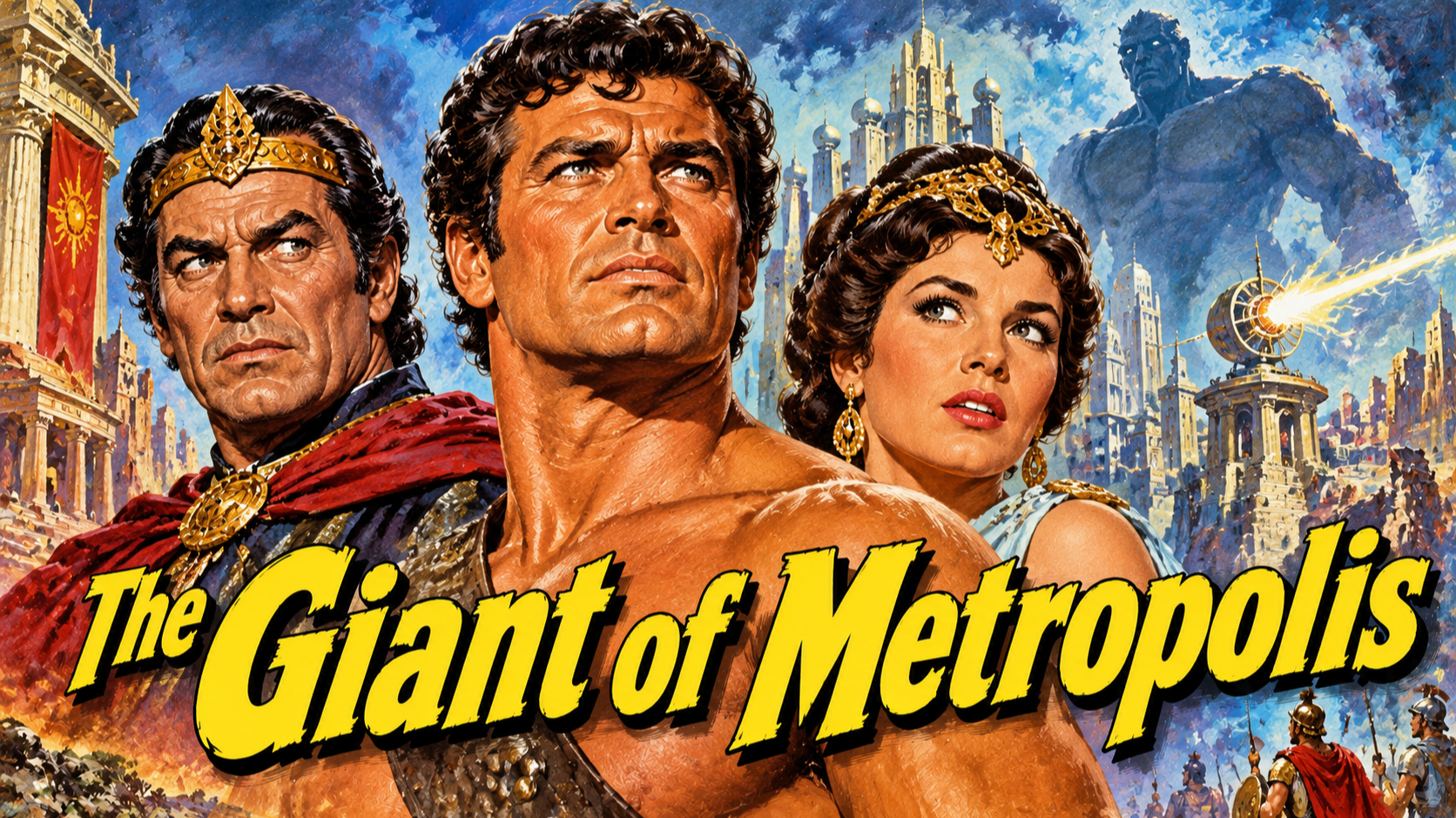
SYNOPSIS
The Giant of Metropolis is an 1961 Italian science-fiction fantasy adventure film directed by Umberto Scarpelli and starring Gordon Mitchell, Bella Cortez, and Roldano Lupi. Set approximately 20,000 years before the present, the story takes place in the technologically advanced city of Metropolis, ruled by the ruthless King Yotar.
When the mighty warrior Obro enters the city, he discovers that its ruler is conducting horrifying scientific experiments in pursuit of immortality. Obro becomes involved in a rebellion against Yotar's tyranny and must fight to save the king's intended victims before a predicted natural catastrophe destroys the city.
PLOT (Spoiler Alert)
In 20,000 B.C., a caravan travels toward the legendary city of Metropolis, a civilization renowned for its extraordinary scientific knowledge and technological achievements. When the caravan's elderly leader dies, his son Obro decides to continue the journey with his three brothers, despite the departure of the other travelers.
As they approach Metropolis, the city's defenses unleash a powerful magnetic storm that kills Obro's brothers. Obro alone survives and is captured by the guards of King Yotar, a cruel and megalomaniacal ruler who intends to create an immortal human being. Impressed by Obro's exceptional physical strength, Yotar decides that the warrior may be useful in his experiments. Meanwhile, the king's scientists and astronomers warn him that a devastating earthquake is approaching, but Yotar refuses to abandon his plans.
Yotar's most disturbing experiment involves removing the brain of his elderly father, Egon, and transplanting it into the body of his young son, Elmos, in the hope of giving the boy immortality and the wisdom of an ancient mind. Queen Texen opposes the experiment and helps save Elmos, but she is killed while freeing Obro. Before dying, she asks Obro to protect her children, Elmos and Princess Meseda. With the assistance of the rebel Ezon, Obro sabotages the king's laboratories and frees prisoners subjected to the experiments. Meseda joins the struggle against her father as the city descends into chaos.
The predicted earthquake finally strikes, devastating Metropolis and bringing the tyrant's reign to an end. As the population turns against Yotar, the king is killed by his own people. Obro escapes the destruction with Meseda and the young Elmos, and the three survivors make their way toward an uncertain future.
PRODUCTION
The film was directed by Umberto Scarpelli and produced by Emimmo Salvi for Centroproduzione Roma. The screenplay involved Sabatino Ciuffini, Oreste Palella, Ambrogio Molteni, Gino Stafford, Umberto Scarpelli, and Emimmo Salvi, with Stafford credited for the original story.
Oberdan Troiani handled cinematography, Franco Fraticelli edited the film, and Armando Trovajoli composed the musical score. Giorgio Giovannini was responsible for production design, Giovanna Natili designed the costumes, and Joseph Nathanson handled special effects. The production combines the traditional Italian peplum adventure with science-fiction imagery, elaborate sets, futuristic machinery, and unusual monsters.
RELEASE
The Giant of Metropolis premiered in Italy on October 25, 1961. The Italian production was distributed by Indipendenti Regionali and subsequently received international distribution under several translated titles.
The film was released theatrically in the United States on September 1, 1963. Running approximately 92 minutes in its commonly circulated English-language version, it became a distinctive example of Italian fantasy cinema, combining sword-and-sandal conventions with futuristic science fiction.
CAST
Gordon Mitchell as Obro
Bella Cortez as Princess Mecede
Roldano Lupi as King Yotar
Liana Orfei as Queen Texen
Marietto Angeletti as Elmos
Furio Meniconi as Egon
Omero Gargano as the Old Sage
Mario Meniconi as Obro's Father
Carlo Tamberlani as Yotar's Father
Luigi Moneta as the Prime Minister
Ugo Sasso as Captain of the Black Guards
Renato Terra as the Young Scientist
Carlo Enrici as the Scientist's Assistant
Leopoldo Savona as the Dancer
CREW
Director: Umberto Scarpelli
Producer: Emimmo Salvi
Executive Producer: Decio Salvi
Story: Gino Stafford
Screenplay: Sabatino Ciuffini, Oreste Palella, Ambrogio Molteni, Gino Stafford, Umberto Scarpelli, and Emimmo Salvi
Cinematography: Oberdan Troiani
Film Editing: Franco Fraticelli
Music: Armando Trovajoli
Production Design: Giorgio Giovannini
Costume Design: Giovanna Natili
Special Effects: Joseph Nathanson
Sound: Sandro Sarandrea
Production Company: Centroproduzione Roma
Italian Distributor: Indipendenti Regionali
IMDb RATING
4.7/10 (IMDb rating at the time of research; ratings may change).
TRIVIA
An unusual combination of genres: The film blends the traditional Italian sword-and-sandal adventure with science fiction, creating a prehistoric world filled with advanced machinery, death rays, and experimental laboratories.
Set 20,000 years in the past: Despite its prehistoric setting, the story features a civilization whose technology is far beyond anything associated with the ancient world.
Gordon Mitchell as Obro: Mitchell was an American bodybuilder and actor who became a familiar face in Italian peplum films.
Atlantis and Metropolis: The film associates its technologically advanced civilization with the legendary lost world of Atlantis.
A mad scientist's ambition: King Yotar's attempt to achieve immortality through brain transplantation is the central science-fiction element of the story.
A remarkable villain: Roldano Lupi portrays King Yotar, whose obsession with scientific supremacy ultimately destroys his kingdom.
A futuristic visual style: The film's sets and machinery give it an unusual appearance, sometimes resembling a low-budget science-fiction serial rather than a conventional historical epic.
Armando Trovajoli's score: The musical soundtrack was composed by the prolific Italian composer, who also worked on numerous comedies, dramas, and adventure films.
International titles: The film was distributed under several different titles, including Il gigante di Metropolis in Italy and Le Géant de Métropolis in France.
A blend of peplum and science fiction: The production is an early example of Italian filmmakers experimenting with futuristic themes within the familiar framework of the muscleman adventure film.

WHAT OUR MOVIE REVIEWERS SAY...

The Giant of Metropolis is an imaginative blend of science fiction, ancient mythology, and sword-and-sandal adventure. Its futuristic city, bizarre scientific experiments, and colorful spectacle create a wonderfully unusual cinematic experience that fans of vintage fantasy will find irresistible.

The Giant of Metropolis is an entertaining curiosity that combines the traditions of the Italian peplum adventure with futuristic science-fiction ideas. Its story is occasionally confusing and its characters rather simplistic, but the imaginative production design and unusual premise give it a distinctive charm.

The Giant of Metropolis promises a spectacular journey into a futuristic world but delivers more confusion than excitement. The wooden performances, clumsy dialogue, and uninspired action make its ambitious premise difficult to appreciate. Even its elaborate settings cannot rescue this sluggish adventure.