

SYNOPSIS:
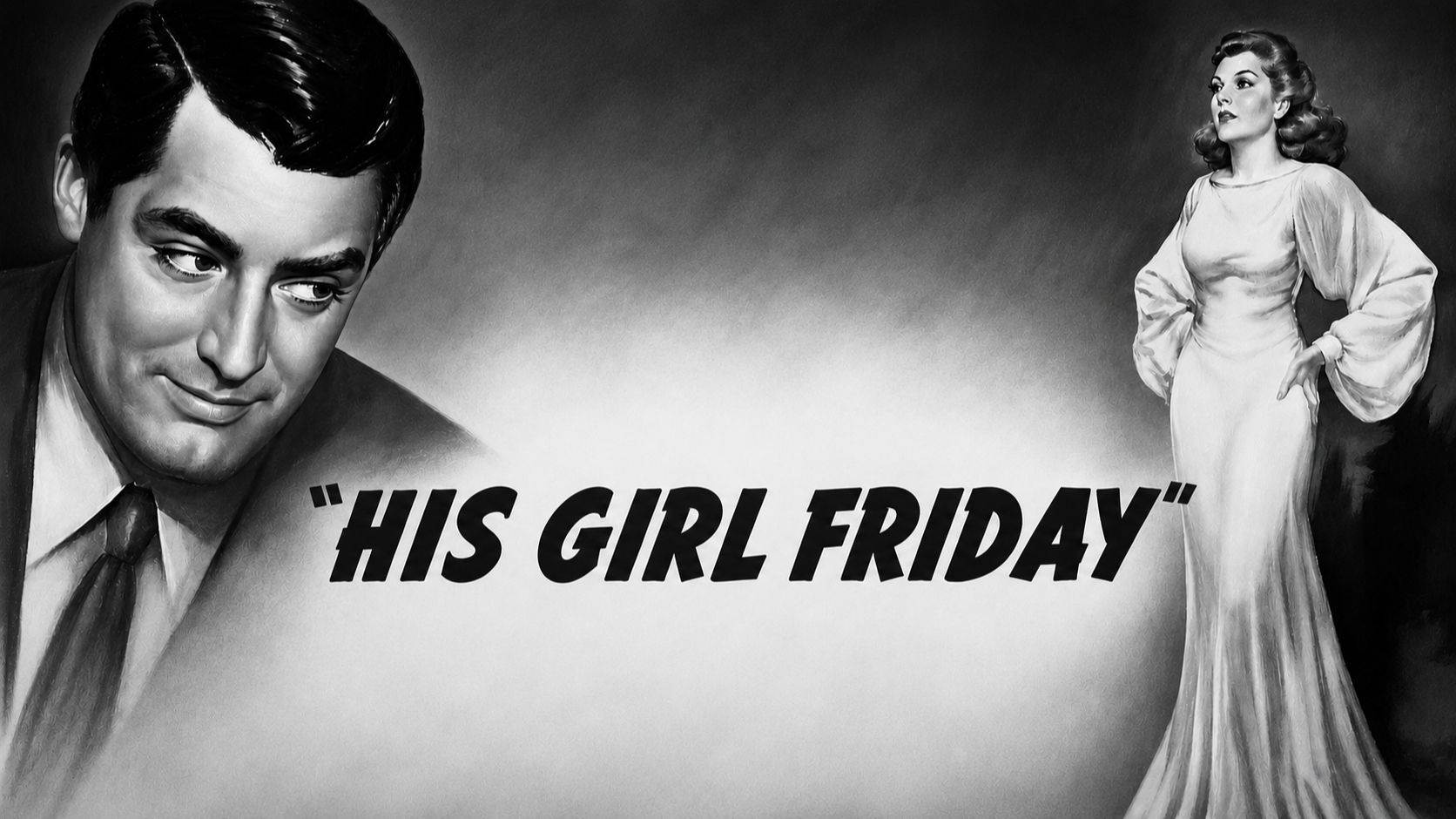
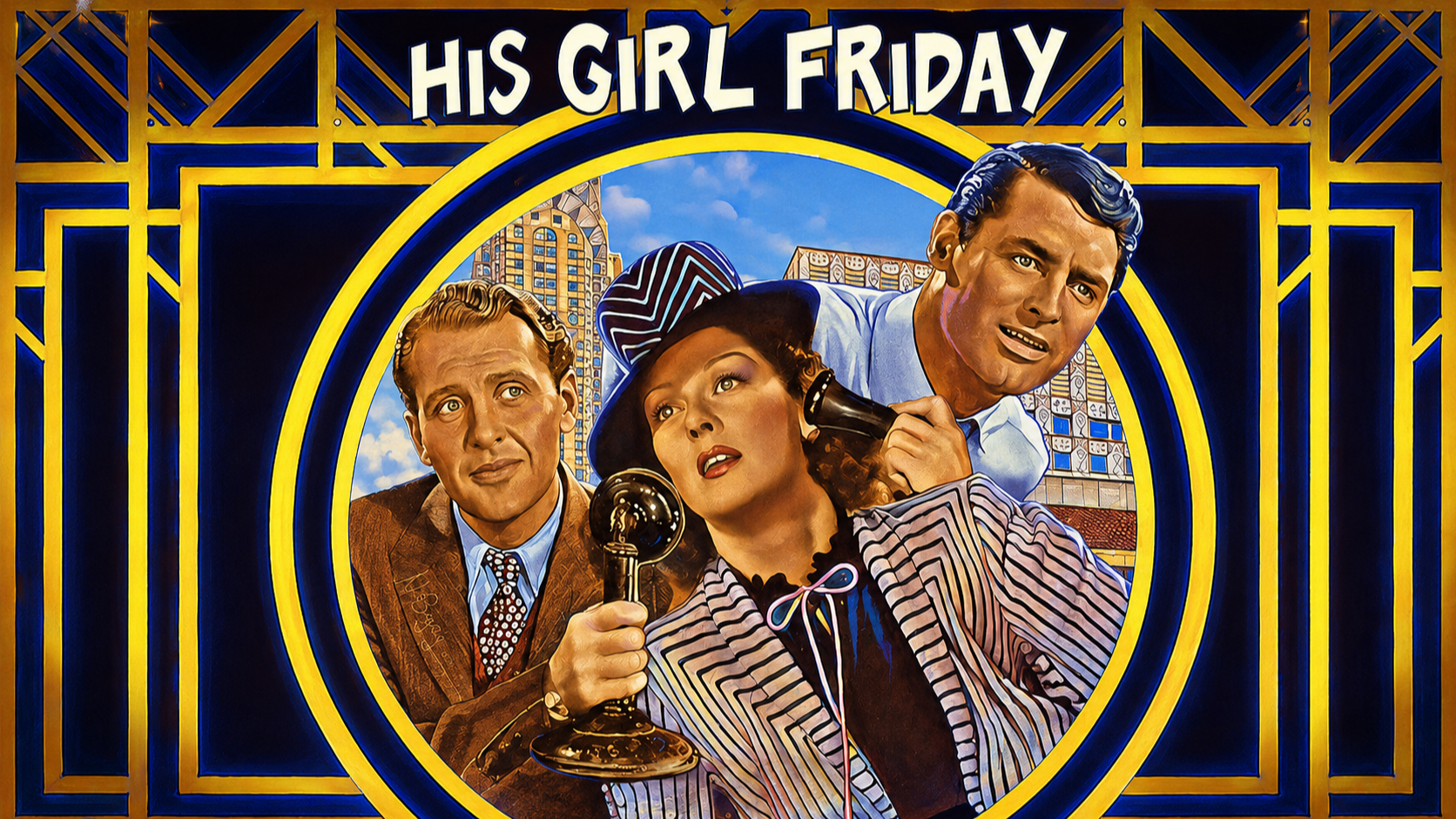
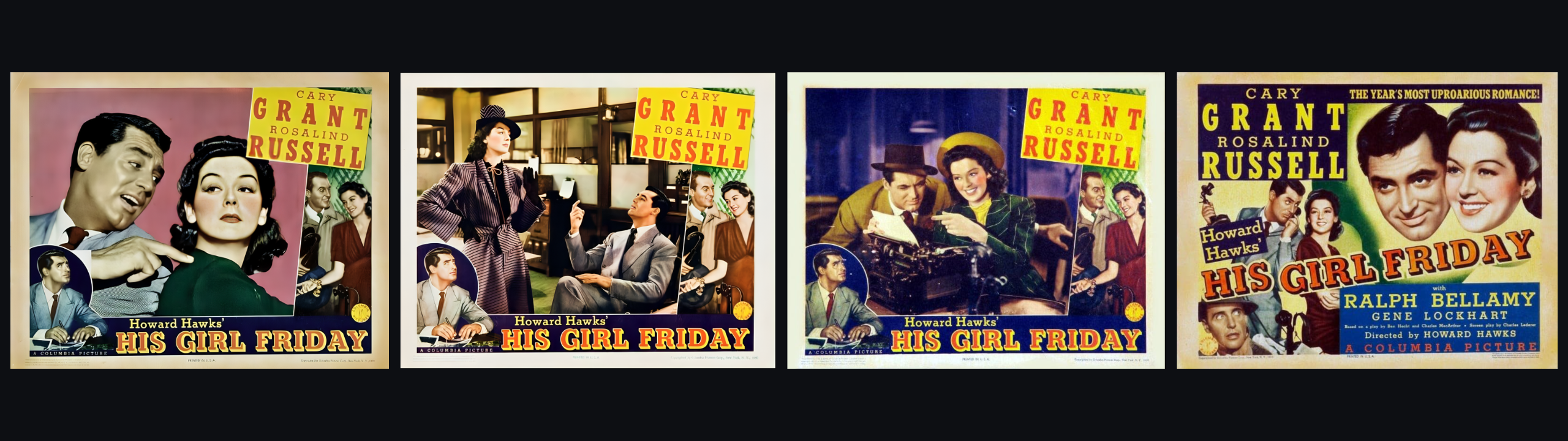
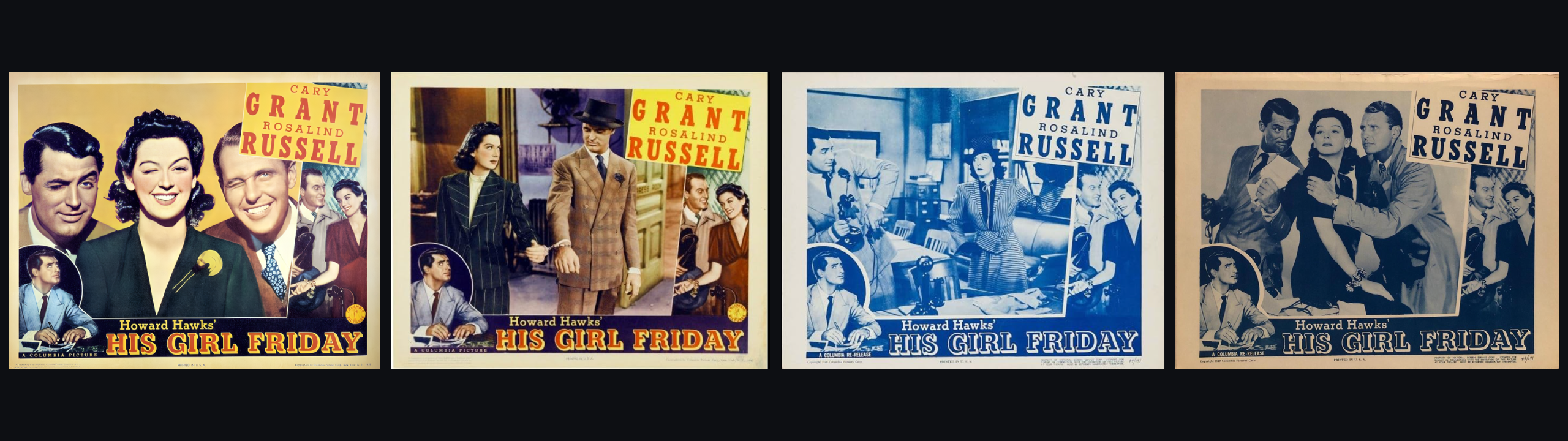
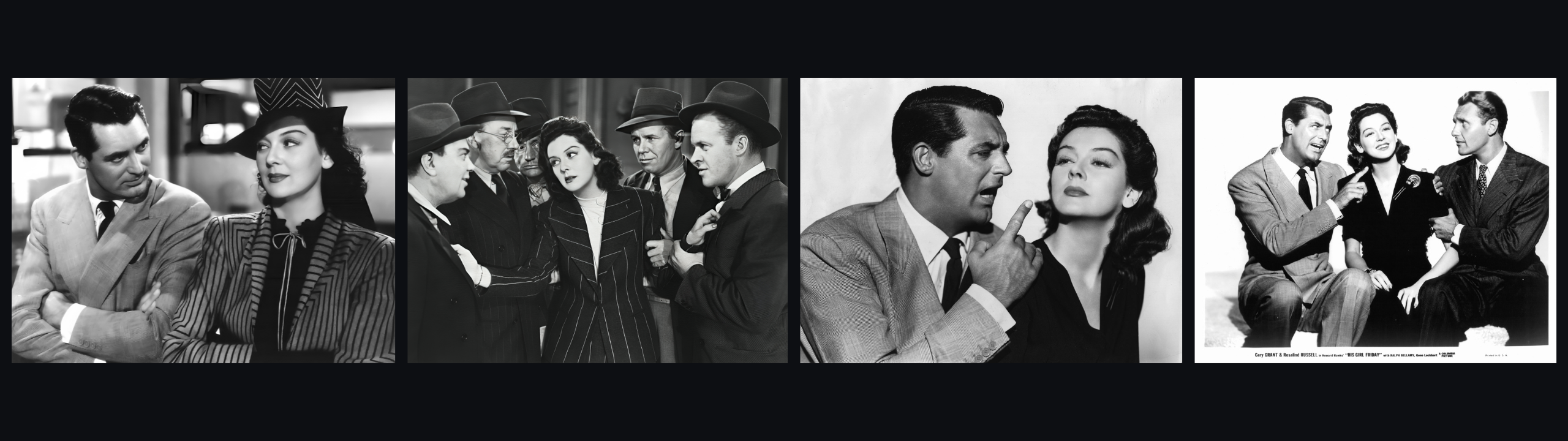
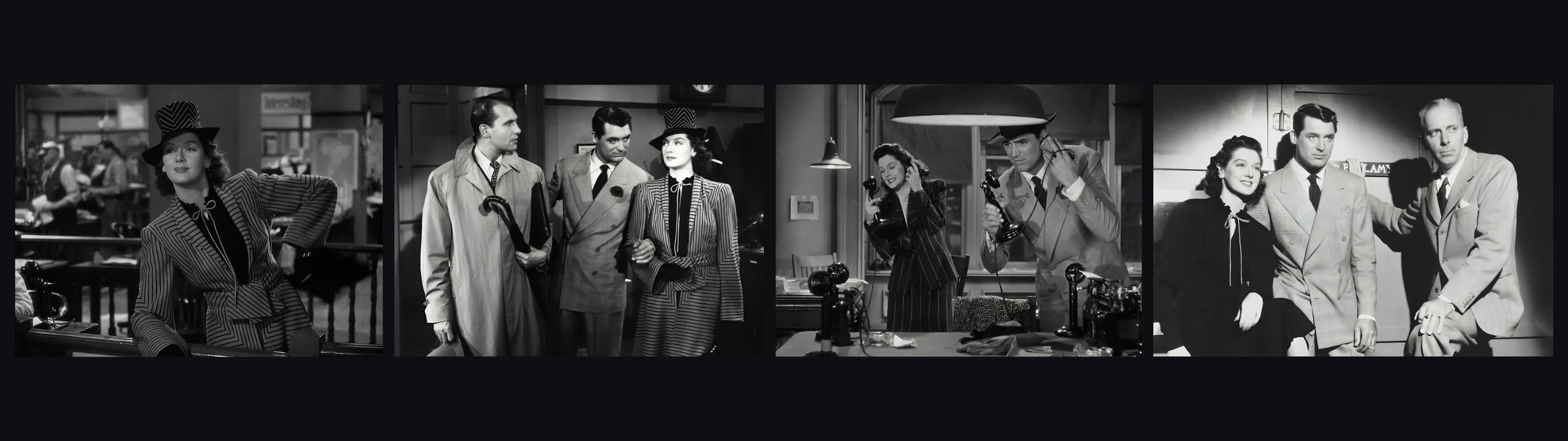
His Girl Friday is a 1940 American screwball comedy film directed by Howard Hawks and starring Cary Grant and Rosalind Russell. Adapted from the acclaimed 1928 Broadway play The Front Page by Ben Hecht and Charles MacArthur, the film tells the story of Walter Burns, a fast-talking newspaper editor determined to prevent his ex-wife and star reporter, Hildy Johnson, from leaving both him and the newspaper business to marry insurance salesman Bruce Baldwin.
When Walter learns of Hildy's plans, he convinces her to cover one last assignment involving the scheduled execution of convicted murderer Earl Williams, hoping the excitement of the story will rekindle both her passion for journalism and their former romance.
As Hildy investigates the case, she discovers evidence suggesting that Earl's conviction may have been influenced by political corruption rather than justice. Together with Walter, she becomes entangled in a whirlwind of deception, hidden fugitives, and relentless police officers, all while Walter employs increasingly outrageous tactics to delay her wedding. The pair race against time to expose the truth behind Earl's conviction before his execution can take place.
Renowned for its exceptionally rapid dialogue, sharp wit, and memorable performances, His Girl Friday is widely regarded as one of the greatest screwball comedies ever produced. Howard Hawks' decision to transform Hildy Johnson into a female character created an entirely new dynamic between the leads, blending romance with newsroom rivalry. The chemistry between Cary Grant and Rosalind Russell, combined with the film's satirical portrayal of journalism, politics, and the legal system, has ensured its enduring reputation as one of Hollywood's finest comedies.
PLOT Spoiler Alert:
His Girl Friday (1940) follows newspaper editor Walter Burns, who is stunned to discover that his former wife and best investigative reporter, Hildy Johnson, intends to leave journalism behind to marry the dependable but naïve Bruce Baldwin and settle into a quieter life. Although their divorce has been finalized, Walter has no intention of losing either Hildy or his newspaper's most talented reporter.
Walter persuades Hildy to remain at the courthouse long enough to cover one final story involving Earl Williams, a mild-mannered bookkeeper convicted of murdering a police officer. Earl's execution has become a political issue, with city officials eager to carry out the sentence before an upcoming election in order to appear tough on crime. Reluctantly, Hildy agrees to write one last article before leaving Chicago forever.
During her investigation, Hildy begins to suspect that Earl is more confused than dangerous and that the authorities have ignored important evidence that could spare his life. Matters become increasingly chaotic when Earl unexpectedly escapes from custody and seeks refuge inside the courthouse press room. Realizing the enormous significance of the story, Hildy hides Earl inside a roll-top desk while she and Walter secretly work to uncover evidence proving his innocence.
Meanwhile, Walter employs every trick imaginable to delay Hildy's departure. He repeatedly arranges for Bruce to be arrested on fabricated charges, strands him without money, and manipulates police officers into believing Bruce is involved in a variety of criminal activities. Each setback delays the wedding while giving Walter more opportunities to convince Hildy that life as a reporter is far more exciting than domestic life.
As the search for Earl intensifies, corrupt city officials attempt to suppress information that could expose their mishandling of the case. Hildy continues writing her exclusive story while Walter uses his influence and quick thinking to keep both Earl and the newspaper one step ahead of the police. Their investigation ultimately reveals that a key witness had been overlooked and that Earl's conviction was based upon incomplete and politically motivated evidence.
The situation reaches its climax when the missing witness finally appears with proof that Earl should never have been sentenced to death. The governor immediately grants Earl a reprieve, exposing the mayor and sheriff's attempts to exploit the execution for political gain. Their corruption becomes public knowledge, and the officials are left humiliated.
With the story successfully published and Earl's life saved, Hildy prepares once again to leave with Bruce. However, Walter's charm, persistence, and the excitement of the breaking news convince her that journalism remains her true calling. Realizing that her relationship with Walter is as irresistible as the fast-paced world of newspaper reporting, Hildy decides to reunite with him instead. The film concludes with the couple announcing plans to remarry, only for Walter to immediately assign Hildy another important news story, suggesting that their personal and professional partnership will continue exactly as before.
PRODUCTION:
Production on His Girl Friday began in late 1939 under the direction of Howard Hawks for Columbia Pictures. The screenplay, written by Charles Lederer, was adapted from Ben Hecht and Charles MacArthur's celebrated play The Front Page. Hawks introduced the film's most significant innovation by changing reporter Hildy Johnson from a male character into Walter Burns' ex-wife, transforming the story into both a romantic comedy and a newsroom satire.
Cary Grant was cast as the charismatic but manipulative Walter Burns, while Rosalind Russell accepted the role of Hildy Johnson after initially expressing reservations about competing with Grant's improvisational style. Russell reportedly worked with an uncredited writer to strengthen many of Hildy's lines, contributing to the character's sharp intelligence and memorable wit. Their on-screen chemistry became one of the film's greatest strengths.
Filming took place primarily on sound stages at Columbia Pictures in California. Much of the action occurs within the courthouse press room, allowing Hawks to emphasize rapid dialogue, overlapping conversations, and constant movement rather than elaborate sets. Cinematographer Joseph Walker employed clean, functional photography that kept the focus firmly on the performances, while editor Gene Havlick maintained the film's remarkable pace. The musical score was composed by Sidney Cutner, with additional music by Morris Stoloff. Completed in early 1940, the film became one of Columbia's most acclaimed productions of the decade.
RELEASE:
His Girl Friday premiered in the United States on January 18, 1940. Critics immediately praised Howard Hawks' energetic direction, the screenplay's sophisticated humor, and the exceptional performances of Cary Grant and Rosalind Russell. Many reviewers highlighted the film's unusually fast dialogue, which distinguished it from other comedies of the period.
Although not among the highest-grossing films of 1940, His Girl Friday proved to be a commercial success for Columbia Pictures and steadily grew in reputation through subsequent theatrical reissues and television broadcasts. Audiences appreciated its clever blend of romance, satire, and newsroom comedy, while journalists frequently cited it as one of the most authentic portrayals of newspaper life ever filmed.
Over the decades, the film has come to be regarded as one of the definitive examples of the screwball comedy genre. Its influence can be seen in countless romantic comedies and newsroom dramas that followed, particularly those featuring fast-paced dialogue and strong professional female leads. The American Film Institute has included His Girl Friday on several of its lists celebrating the greatest American films and comedies, while critics continue to rank it among Howard Hawks' finest achievements.
Today, His Girl Friday remains a classic of Hollywood's Golden Age. Its combination of intelligent writing, unforgettable performances, and timeless humor continues to attract new audiences, and it is widely considered one of the greatest newspaper films ever made.
CAST:
Cary Grant as Walter Burns
Rosalind Russell as Hildy Johnson
Ralph Bellamy as Bruce Baldwin
Gene Lockhart as Sheriff Peter B. Hartwell
Porter Hall as Murphy
Ernest Truex as Bensinger
Cliff Edwards as Endicott
John Qualen as Earl Williams
Helen Mack as Mollie Malloy
Roscoe Karns as McCue
Abner Biberman as Louie
Billy Gilbert as Joe Pettibone
CREW:
Director: Howard Hawks
Producer: Howard Hawks
Screenplay: Charles Lederer
Based on the play: The Front Page by Ben Hecht and Charles MacArthur
Cinematographer: Joseph Walker
Editor: Gene Havlick
Music: Sidney Cutner and Morris Stoloff
Production Company: Columbia Pictures
Distributor: Columbia Pictures
Release Date: January 18, 1940
Country of Origin: United States
Running Time: 92 minutes
Budget: Approximately $796,000
Box Office Return: Estimated $1.6 million (U.S. rentals)
IMDb Rating = 7.8 / 10
TRIVIA:
Howard Hawks decided to make Hildy Johnson a woman after imagining how much more entertaining the story would become if the two lead characters were divorced.
Rosalind Russell secretly hired writer Arthur Kober to improve many of her dialogue exchanges, giving Hildy even sharper wit.
The film is famous for its rapid-fire, overlapping dialogue, which was unusual for Hollywood films of the time and became one of its defining characteristics.
Cary Grant improvised several of Walter Burns' funniest lines during filming, many of which were retained in the finished picture.
Ralph Bellamy became so closely associated with playing the dependable but unsuccessful romantic rival that his role in His Girl Friday helped establish a recurring Hollywood stereotype.
The film has frequently been cited by journalists as one of the most accurate portrayals of the fast-paced atmosphere of newspaper reporting during the early twentieth century.
His Girl Friday has appeared on numerous "greatest films" and "greatest comedies" lists compiled by critics and film organizations around the world.
The American Film Institute ranked His Girl Friday among the greatest American comedies ever made.
Howard Hawks considered the film one of his personal favorites and often cited it as an example of the importance of fast pacing and natural dialogue.
Despite being over eighty years old, His Girl Friday remains one of the most influential screwball comedies ever produced and continues to inspire filmmakers and writers today.
Rosalind Russell thought, while shooting, that she didn't have as many good lines as Cary Grant had, so she hired an advertisement writer through her brother-in-law and had him write more clever lines for the dialog. Since Howard Hawks allowed for spontaneity and ad-libbing, he, and many of the cast and crew didn't notice it, but Grant knew she was up to something, leading him to greet her every morning: "What have you got today?"
One of the first films (preceded by Stage Door (1937)) to have characters talk over the lines of other characters, for a more realistic sound. Prior to this, movie characters completed their lines before the next lines were started.
It is estimated that the normal rate of verbal dialogue in most films is around 90 words a minute. In His Girl Friday (1940), the delivery has been clocked at 240 words a minute.
To maintain the fast pace, Howard Hawks encouraged his cast to add dialogue and funny bits of business and step on each others lines whenever possible.
During the 1930s, Howard Hawks was hosting a dinner party when the topic of dialogue was brought up. He pulled out a copy of "The Front Page" to demonstrate the snappy exchanges between characters, taking the role of Burns. A female guest took the role of Hildy. While reading, Hawks realized the dialogue sounded much better with a woman reading, and quickly secured the rights for the film from Howard Hughes. Ben Hecht (the author of "The Front Page") approved the gender change and the screenplay was put into production.
OUR MOVIE REVIEWERS SAY...

"Howard Hawks has delivered one of the sharpest and most exhilarating comedies of the year. The lightning-fast dialogue never loses its wit, while the chemistry between Cary Grant and Rosalind Russell is nothing short of electric. Every scene crackles with energy, making the newsroom setting feel alive with urgency and humor. His Girl Friday is a masterclass in comedic timing that rewards attentive audiences with constant laughs and clever surprises."

"His Girl Friday is an energetic newspaper comedy that relies heavily on rapid-fire dialogue and relentless pacing. While the performances are undeniably strong, the speed of the conversations may leave some viewers struggling to keep pace with the story. The film offers plenty of amusing moments and memorable exchanges, though its emphasis on verbal sparring occasionally overshadows its emotional depth. Fans of sophisticated comedy will likely appreciate its style more than those seeking a traditional romantic picture."

"Although His Girl Friday boasts talented performers and an ambitious script, its breakneck pace often works against it. The constant barrage of dialogue leaves little room for the characters or dramatic moments to breathe, making the film feel exhausting rather than entertaining. Much of the humor depends on clever wordplay delivered at such speed that many jokes are easily missed. While some audiences may admire its frantic energy, others may find it more overwhelming than amusing."