
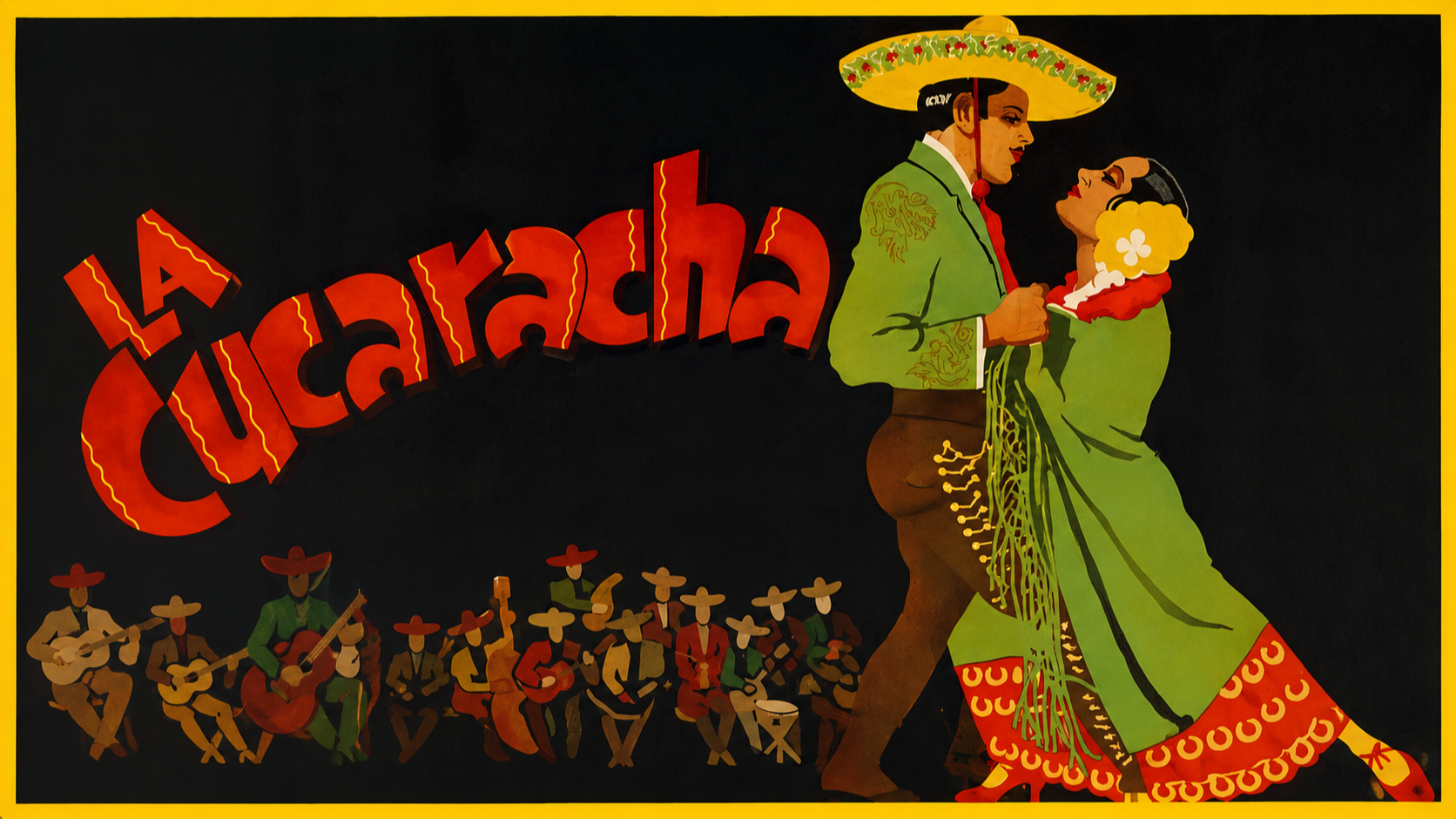
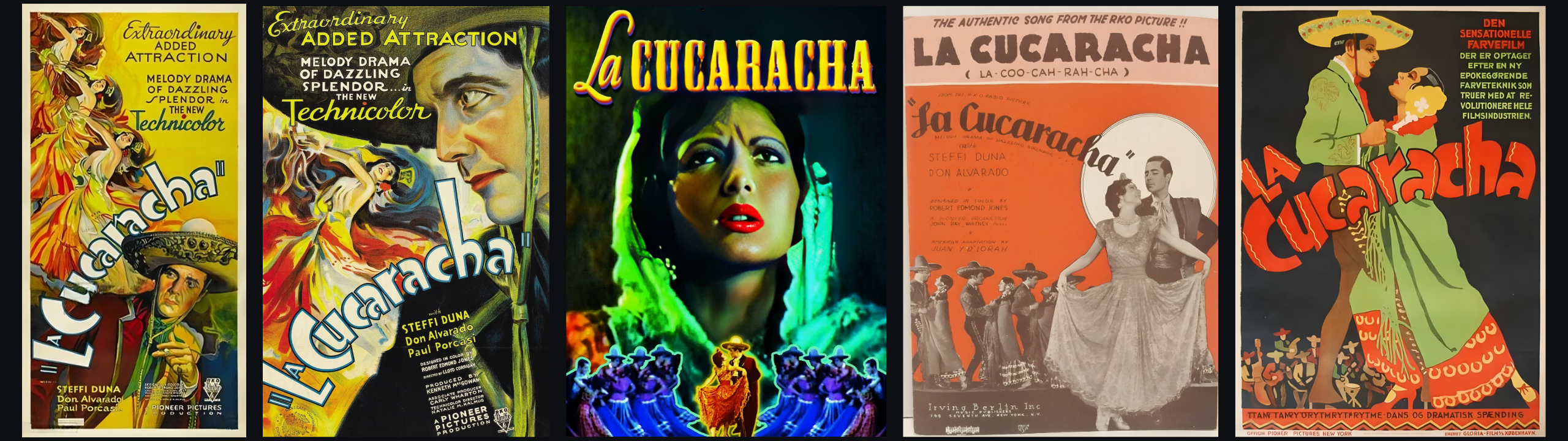
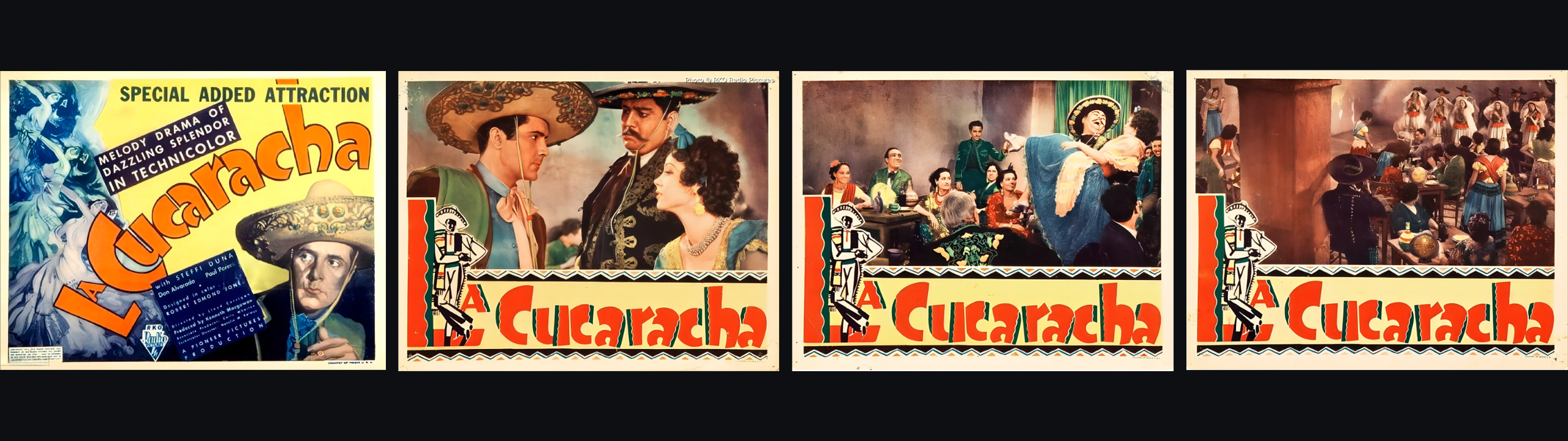

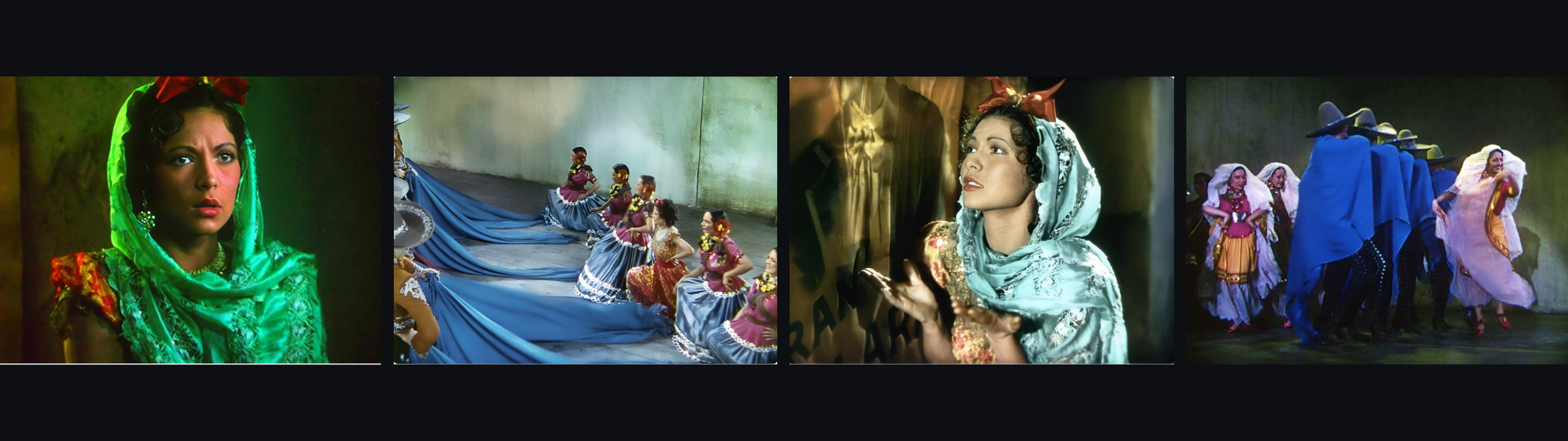
SYNOPSIS: La Cucaracha is a 1934 American musical comedy short film directed by Lloyd Corrigan and starring Steffi Duna, Don Alvarado, and Paul Porcasi. Produced by Pioneer Pictures, the film is best remembered as one of the earliest live-action productions photographed entirely in the groundbreaking three-strip Technicolor process, showcasing the vibrant possibilities of color filmmaking at a time when most motion pictures were still produced in black and white.
Set in a lively Mexican village, the story follows Señor Martinez, a wealthy café owner searching for a talented performer to entertain his patrons, and the spirited dancer Señorita Cucaracha, whose charm and determination quickly make her the center of attention.
As Señorita Cucaracha earns the admiration of both the audience and Martinez, she finds herself competing with another performer whose jealousy threatens to derail her newfound success. Through a series of energetic musical numbers, colorful performances, and lighthearted misunderstandings, the rivalry builds toward a lively finale that celebrates talent, romance, and perseverance. Although simple in its narrative, the film uses music and dance to highlight its characters while serving as a showcase for the revolutionary Technicolor process.
Despite its brief running time, La Cucaracha is considered one of the most historically significant short films ever produced. Its dazzling use of color demonstrated the commercial potential of three-strip Technicolor and helped convince Hollywood studios to embrace the technology for future feature films. Today, the film is recognized not only as an entertaining musical short but also as an important milestone in cinema history, marking the beginning of the modern era of color filmmaking.
PLOT Spoiler Alert: La Cucaracha (1934) centers on Señorita Cucaracha, a spirited young dancer living in a colorful Mexican village who dreams of becoming the featured entertainer at the local Café Estrada. The café's owner, Señor Martinez, is searching for fresh talent to attract larger crowds, and Cucaracha eagerly seizes the opportunity to audition despite facing competition from an established performer.
Her lively singing and energetic dancing quickly captivate both Martinez and the café's patrons, but her success sparks jealousy from her rival, leading to a series of humorous confrontations and backstage disputes. Determined to prove herself, Cucaracha refuses to be discouraged and continues performing with confidence and enthusiasm.
As tensions rise, the rivalry culminates in a spirited musical finale where Cucaracha's natural charisma and undeniable talent win over the audience. Her performance secures her place as the café's newest star, while the conflict is resolved on a lighthearted note. The film concludes with a joyful celebration of music, dance, and romance, leaving audiences with an optimistic ending that perfectly complements its vibrant Technicolor presentation.
PRODUCTION: Production of La Cucaracha began in 1934 under Pioneer Pictures, with Lloyd Corrigan directing and Kenneth Macgowan producing. The screenplay was written by Ray Harris and Edgar G. Ulmer, inspired by the popular traditional Spanish folk song of the same name. Although the story itself was relatively simple, the production's primary objective was to demonstrate the capabilities of the newly developed three-strip Technicolor process.
Filmed almost entirely on studio sets, the production emphasized elaborate costumes, colorful scenery, and carefully designed lighting to maximize the impact of the new technology. Cinematographer Ray Rennahan, one of Technicolor's leading specialists, worked closely with the production team to achieve vivid, natural-looking colors that had not previously been possible in live-action filmmaking.
Running just over twenty minutes, La Cucaracha served as both an entertaining musical comedy and a technical demonstration. Its success convinced many Hollywood producers that full-color photography could become commercially viable, paving the way for later Technicolor classics throughout the 1930s and beyond.
RELEASE: La Cucaracha premiered in 1934 and immediately attracted attention for its remarkable color photography. While audiences enjoyed its music, dancing, and lighthearted story, critics were especially impressed by the richness and realism of the three-strip Technicolor process, which represented a major advancement over earlier color systems.
The film received an Academy Award for Best Short Subject (Comedy) and became an important promotional tool for Technicolor. Its commercial and critical success demonstrated that audiences were enthusiastic about high-quality color productions, encouraging major studios to invest in the new technology.
Today, La Cucaracha is remembered less for its narrative than for its historic contribution to filmmaking. Frequently screened by film historians and preservation societies, it remains a landmark achievement in the development of color cinema and an essential chapter in the history of Hollywood's technological innovation.
CAST:
Steffi Duna as Señorita Cucaracha
Don Alvarado as Señor Martinez
Paul Porcasi as Café Proprietor
Eduardo Durant's Orchestra as The Musicians
CREW:
Director: Lloyd Corrigan
Producer: Kenneth Macgowan
Writers: Ray Harris, Edgar G. Ulmer
Cinematographer: Ray Rennahan
Editor: Gene Milford
Music: Traditional Spanish folk music arranged for the production
Production Company: Pioneer Pictures
Distributor: RKO Radio Pictures
Release Date: August 31, 1934
Country of Origin: United States
Running Time: 20 minutes
Budget: Approximately $65,000
Box Office Return: N/A
IMDb Rating = 6.5 / 10
TRIVIA:
La Cucaracha was one of the first live-action films photographed entirely using the revolutionary three-strip Technicolor process.
The film won the Academy Award for Best Short Subject (Comedy) at the 7th Academy Awards.
Its primary purpose was to demonstrate the commercial potential of the new Technicolor system to Hollywood studios.
Cinematographer Ray Rennahan became one of the pioneers of color cinematography and later photographed numerous Technicolor classics.
The title comes from the famous traditional Spanish folk song "La Cucaracha," which inspired the film's musical theme.
Although only twenty minutes long, the film played a significant role in convincing studios to adopt color photography for feature-length productions.
The elaborate costumes and brightly decorated sets were specifically designed to showcase the vivid capabilities of three-strip Technicolor.
Today, La Cucaracha is preserved by film archives as an important milestone in the history of color filmmaking.
The success of the film helped pave the way for later Technicolor classics such as Becky Sharp (1935) and The Wizard of Oz (1939).
Despite its historical importance, La Cucaracha remains an entertaining musical short that continues to be appreciated by classic film enthusiasts and cinema historians alike.
The first full-color live-action film.
Carly Wharton was married to John Wharton, the lawyer for wealthy investor John Hay Whitney. She once told how, in the course of a conversation about Technicolor, she and Robert Edmond Jones were "recruited" by Whitney at a cocktail party given by him.
Natalie Kalmus, wife of Technicolor developer Herbert T. Kalmus, didn't like the use of colored lights in the production. However, upon leaving the studio she was struck by a car and hospitalized, so the production continued with the theatrical colored lighting plan, ignoring her dictum.
Flicker Alley DVD and Blu-ray included a beautifully restored version of the short in part 4 of Les premiers pas du cinéma - À la recherche du son (2003), also known as 'Discovering Cinema: "Learning to Talk" & "Movies Dream in Color"'.
OUR MOVIE REVIEWERS SAY...

"A vibrant and entertaining musical short that showcases dazzling performances and groundbreaking early color cinematography. Its energy and visual charm make it a memorable piece of film history."

"La Cucaracha is an enjoyable musical short that serves as both light entertainment and an important technological milestone. While its simple story leaves little lasting impact, its historical significance remains undeniable."

"Although visually impressive for its era, the film's thin plot and brief runtime offer limited depth beyond its musical spectacle. Viewers seeking a more substantial story may find it lacking."