
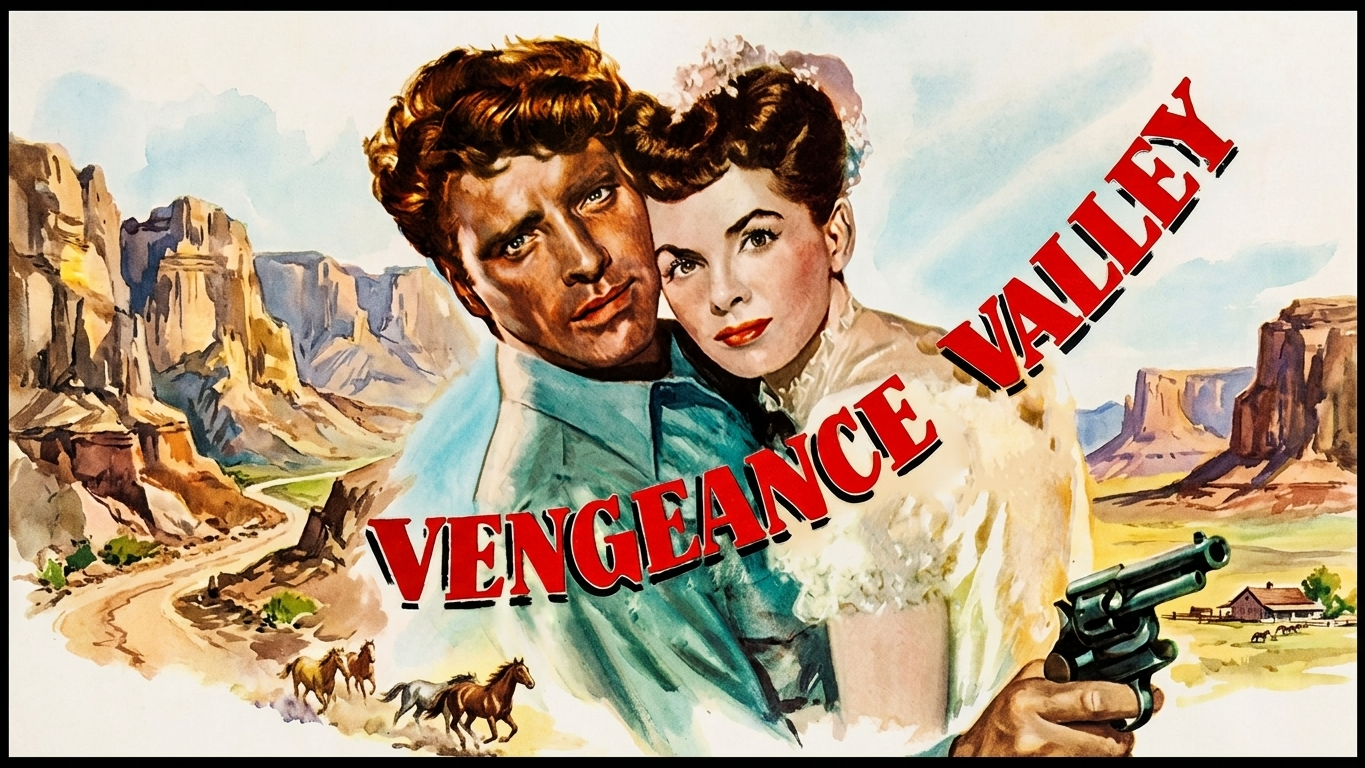
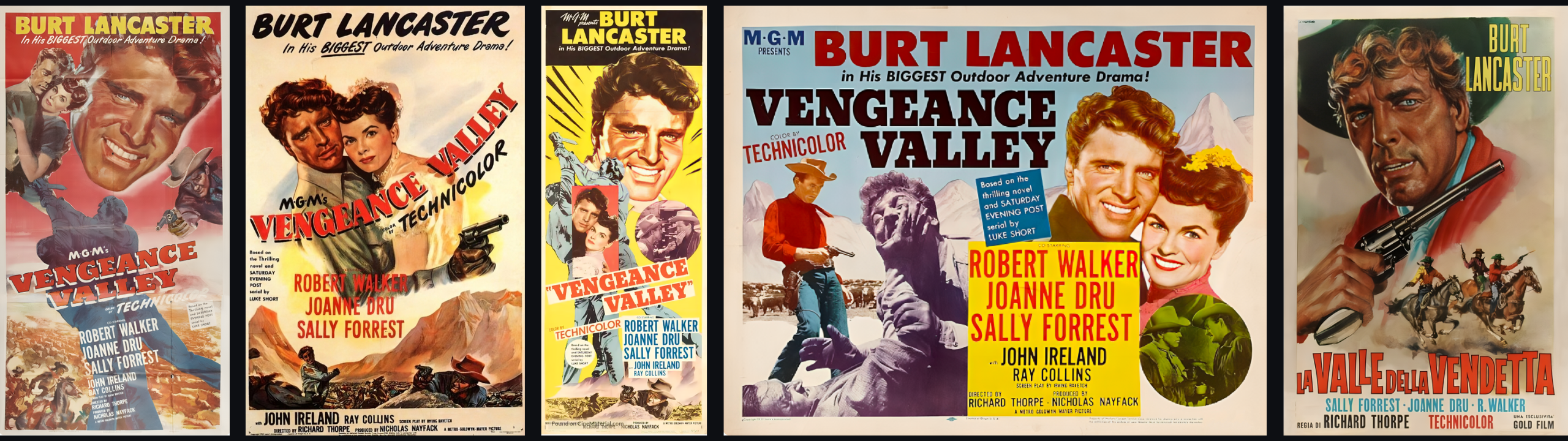
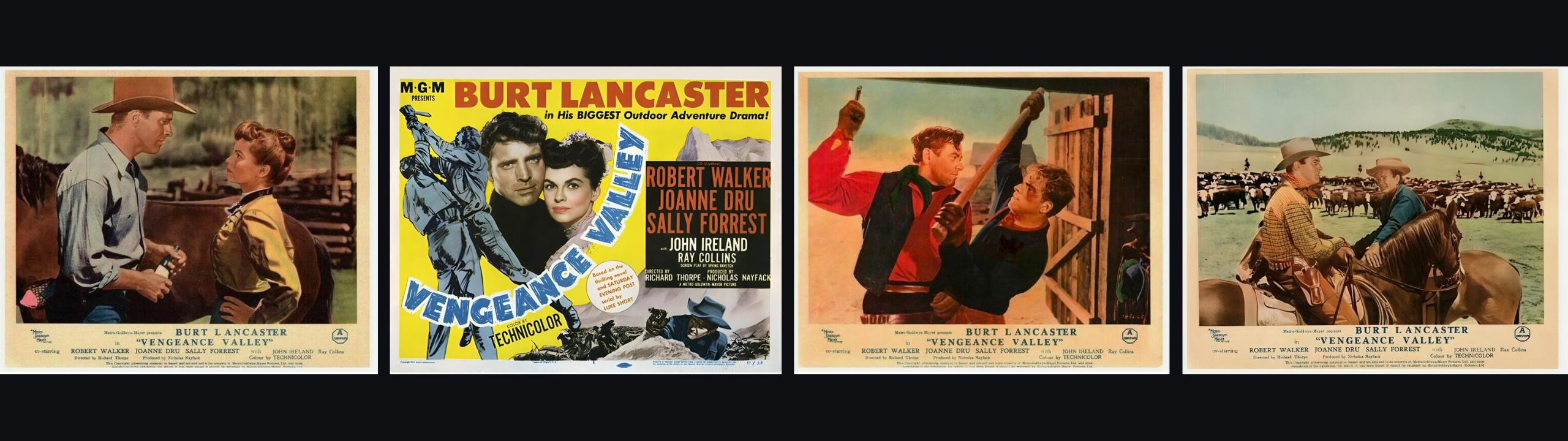
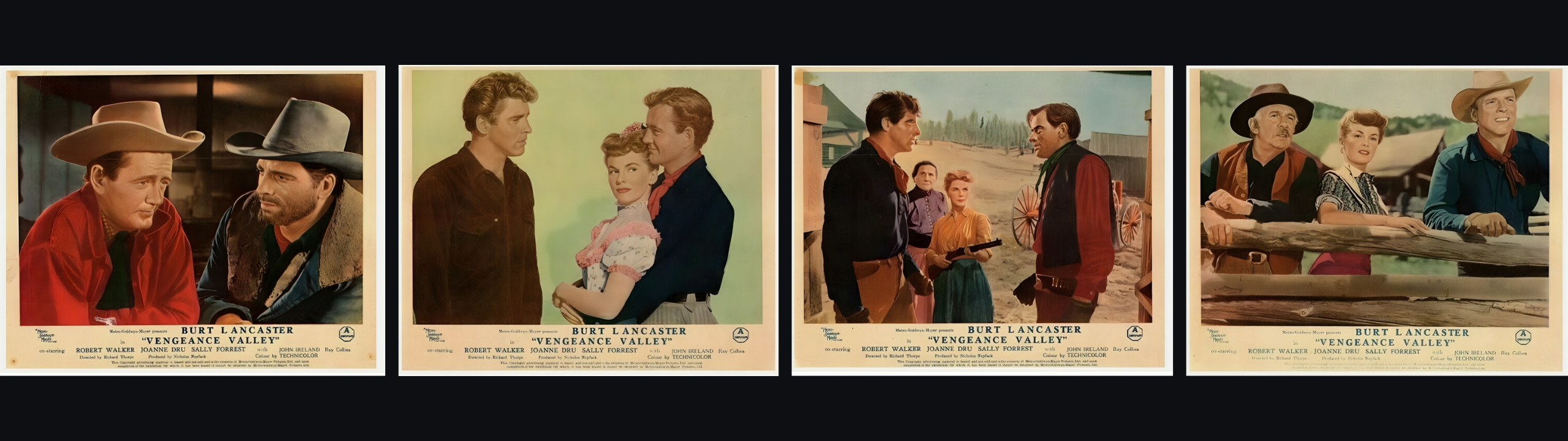
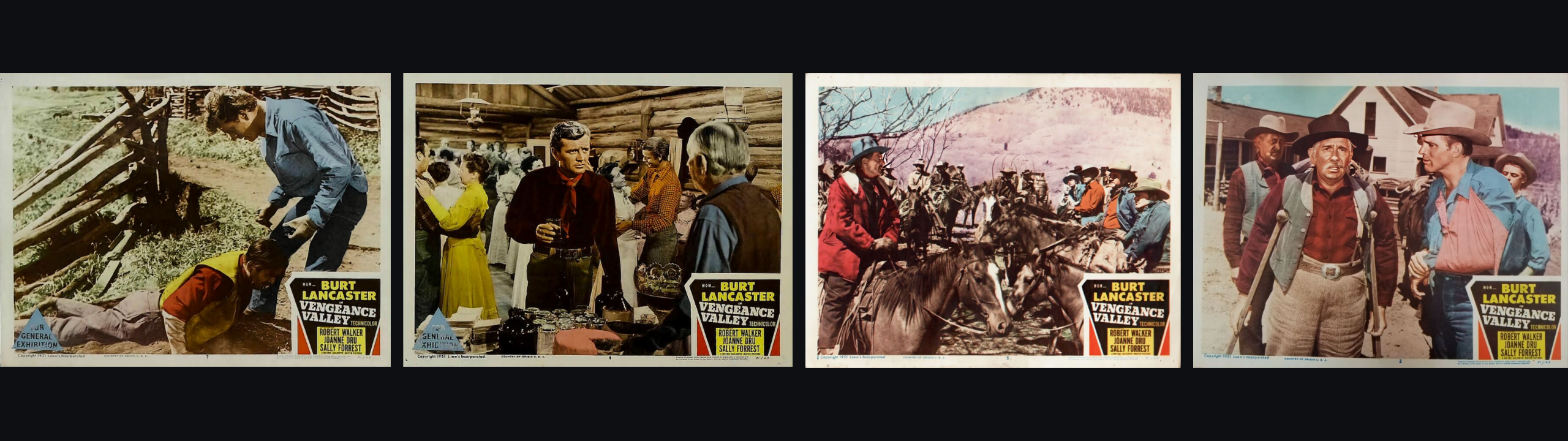
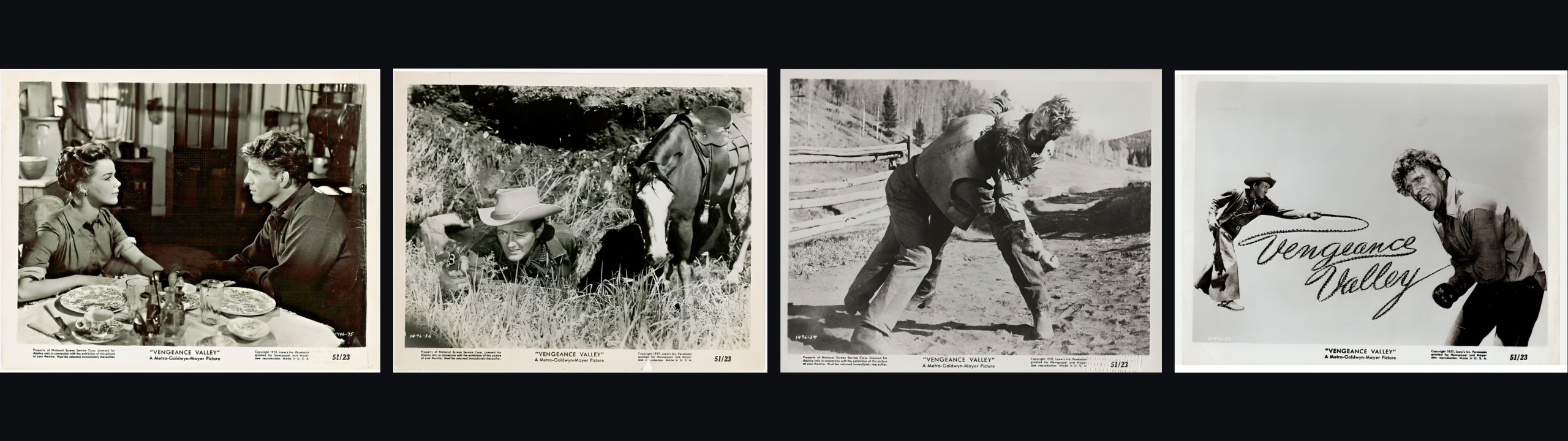
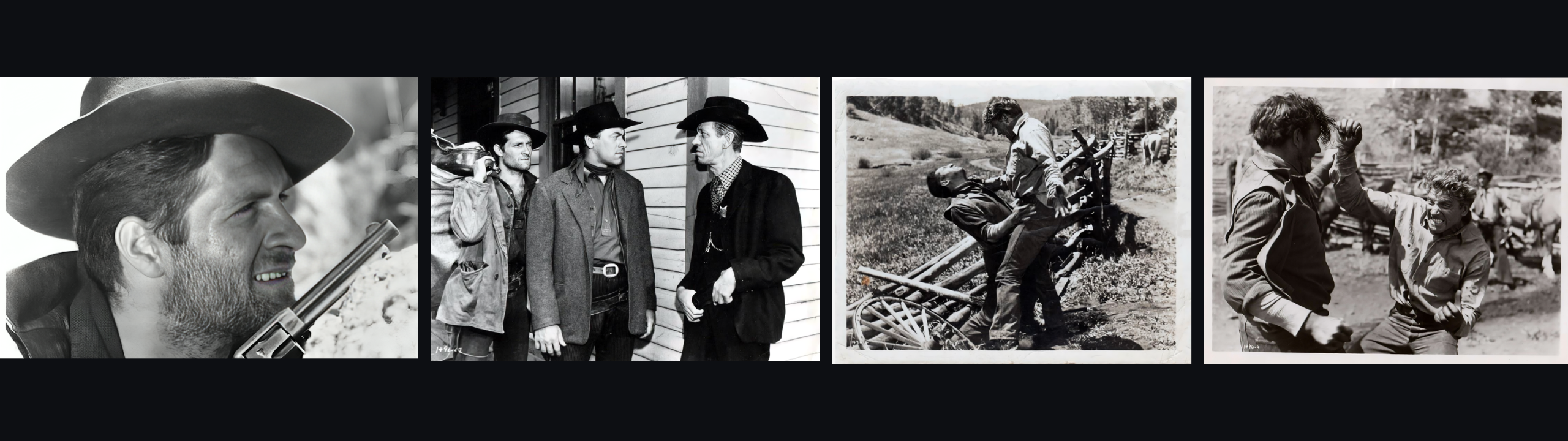
Vengeance Valley (1951) is an American Technicolor Western directed by Richard Thorpe and written by Irving Ravetch, based on the 1950 novel by Luke Short. The film stars Burt Lancaster as Owen Daybright, Robert Walker as Lee Strobie, Joanne Dru as Jen Strobie, Sally Forrest as Lily Fasken, John Ireland as Hub Fasken, and Ray Collins as Arch Strobie. Produced by Nicholas Nayfack for Metro-Goldwyn-Mayer, the film is notable as Burt Lancaster's first Western and for being one of Robert Walker's final MGM films.
The story centers on Owen Daybright, the loyal foster son and ranch foreman of wealthy Colorado cattleman Arch Strobie. Owen has spent fifteen years helping raise Arch's troubled biological son, Lee, but the two men have developed very different characters. When an unmarried young woman, Lily Fasken, gives birth, Owen secretly provides her with money because he knows Lee is the child's father. His silence causes Lily's brothers to suspect him, while Lee attempts to conceal his own responsibility. The situation becomes increasingly dangerous as Lee's resentment toward Owen grows.
Shot in Technicolor, the film combines the conventions of the Western with a story centered on family loyalty, jealousy, betrayal, and moral responsibility. George J. Folsey's photography makes extensive use of Colorado locations, while Rudolph G. Kopp's score supports the film's restrained dramatic tone. The performances of Lancaster and Walker form the center of the production, with Lancaster portraying Owen's integrity and Walker giving Lee a volatile and increasingly destructive character. The film remains an effective example of the psychologically oriented Westerns emerging in the early 1950s.
PLOT (Spoiler Alert)
After returning from a cattle drive, ranch foreman Owen Daybright learns that unmarried Lily Fasken has given birth. Owen secretly gives Lily $500 to help care for the child, knowing that her baby's father is actually his foster brother, Lee Strobie. Lily refuses to identify the father, while Lee continues his irresponsible behavior. Lily's brothers, Dick and Hub Fasken, assume Owen is responsible and confront him. Owen refuses to reveal Lee's secret, even though doing so would clear his own name. At the Strobie ranch, Owen continues to protect Lee despite Arch's clear preference for Owen and Lee's growing resentment toward his foster brother.
Lee's wife, Jen, eventually realizes that Lee is Lily's child's father after noticing that he withdrew the same amount of money Owen gave Lily. Lee attempts to blame Owen, but Jen rejects his lie and becomes increasingly disillusioned with her husband. Meanwhile, Owen tries to persuade Lee to leave the ranch and make a new beginning, but Lee becomes convinced that Owen wants control of Arch's property. Lee later persuades Arch to make him a half-owner of the ranch, only to discover that Arch intends his own half to pass to Owen after his death. Lee's jealousy deepens. After a confrontation involving cattle rustler Herb Backett, Lee also becomes suspicious when he finds Jen tending to Owen after Owen has been injured.
Lee secretly conspires with Backett to eliminate Owen during the upcoming cattle drive. He arranges for the Fasken brothers to join the eastern portion of the drive while Owen leads the western herd, intending for them to ambush Owen when the two groups meet. Lee also attempts to sell the Strobie cattle without his father's knowledge. As the drives converge, Owen learns that Dick and Hub are working with Lee.
Lee temporarily pretends to reconcile with Owen and persuades him to ride with him to resolve the cattle-sale dispute. During the journey, Dick and Hub ambush the pair. Lee abandons Owen, leaving him to face the attackers alone. Owen survives the shooting, while Dick and Hub are killed when Owen's ranch hands arrive.
Owen then pursues Lee and confronts him at the river. Lee reminds Owen that he has always been the better gunman, but Owen draws first and kills him. Owen returns to the ranch and tells Arch what happened.
Arch realizes that his failure to acknowledge Lee's character contributed to the tragedy and accepts responsibility for his part in the family's destruction. Owen then goes to Jen and tells her that Lee is dead, choosing to deliver the news himself. With Lee's schemes finally ended, Owen's loyalty and integrity are vindicated, and the ranch is left in the hands of those who survived the conflict.
PRODUCTION
Vengeance Valley was produced by Nicholas Nayfack for Metro-Goldwyn-Mayer and directed by Richard Thorpe. The screenplay by Irving Ravetch was adapted from Luke Short's novel, which had originally been serialized in The Saturday Evening Post from December 1949 through January 1950 before appearing in book form in 1950. Production took place from early June through early July 1950. Much of the film was shot on location in Canon City, Colorado, with additional location work reported at Coal Creek and Oak Creek.
The film was photographed in Technicolor by George J. Folsey, with Cedric Gibbons and Malcolm Brown serving as art directors and Conrad A. Nervig as editor. Walter Plunkett designed the costumes, while Rudolph G. Kopp composed the music and Douglas Shearer supervised the recording. Carleton Carpenter's character, Hewie, provides intermittent voice-over narration. The production used the Colorado locations to give the cattle-drive sequences a naturalistic appearance rather than relying exclusively on MGM's studio facilities.
RELEASE
Vengeance Valley received its Colorado premiere in Canon City and Florence on February 6, 1951, followed by its New York opening on February 14. Its general release date is recorded by the American Film Institute as February 16, 1951. Metro-Goldwyn-Mayer produced the film and Loew's distributed it. The finished picture ran approximately 82–83 minutes and was presented in Technicolor with Western Electric sound.
Contemporary reviews generally regarded the film as a solid but unconventional Western, with particular attention given to its Colorado location photography and Lancaster's performance. It was commercially successful: MGM records report $1,997,000 in U.S. and Canadian rentals and $1,149,000 from other territories, for approximately $3.146 million in total rentals. The film later entered the U.S. public domain in 1979 when its copyright was not renewed, resulting in numerous inexpensive home-video editions.
CAST
Burt Lancaster as Owen Daybright
Robert Walker as Lee Strobie
Joanne Dru as Jen Strobie
Sally Forrest as Lily Fasken
John Ireland as Hub Fasken
CREW
Director: Richard Thorpe
Producer: Nicholas Nayfack
Writer: Irving Ravetch
Based on: Vengeance Valley by Luke Short
Cinematographer: George J. Folsey
Editor: Conrad A. Nervig
Art Directors: Cedric Gibbons, Malcolm Brown
Set Decorators: Edwin B. Willis, Alfred E. Spencer
Costume Designer: Walter Plunkett
Music: Rudolph G. Kopp
Sound: Douglas Shearer
Production Company: Metro-Goldwyn-Mayer
Distributor: Loew's Inc.
Release Date: February 16, 1951
Country of Origin: United States
Running Time: 82–83 minutes
Budget: Approximately $1,008,000
Box Office Return: Approximately $3,146,000 in worldwide rentals
IMDb Rating
IMDb Rating = 5.9 / 10
TRIVIA
Vengeance Valley was Burt Lancaster's first Western. He had previously appeared primarily in crime dramas, film noirs, and adventure pictures.
Lancaster was borrowed from Wallis-Hazen, Inc. by MGM specifically for the production.
The film was adapted from Luke Short's novel Vengeance Valley, which was serialized in The Saturday Evening Post before its publication as a book.
The film marked Robert Walker's final MGM film. He had been one of the studio's important contract stars during the 1940s.
Walker died in August 1951, only months after the film's release.
Carleton Carpenter's Hewie provides intermittent voice-over narration, an unusual structural device for a Western of the period.
The production filmed extensively around Canon City, Colorado, where the film also received its premiere.
Additional Colorado location work was conducted around Coal Creek and Oak Creek.
The film was photographed entirely in Technicolor, with George J. Folsey serving as director of photography.
The picture's central conflict deliberately places an adopted son against a biological son, with Arch Strobie's differing relationships with Owen and Lee driving much of the story.
Vengeance Valley was one of the MGM productions from the 1950–51 period whose U.S. copyright was ultimately not renewed, causing it to enter the public domain in 1979.
The film's reported MGM earnings were $1.997 million from the United States and Canada and $1.149 million from other territories, making it a commercially successful production for its period.
OUR MOVIE REVIEWERS SAY...

"Vengeance Valley is a tough, atmospheric Western elevated by Burt Lancaster's commanding performance. The rugged Montana locations, tense family conflict, and brisk action give the film a muscular quality that makes it considerably more than a routine cowboy picture."

"Vengeance Valley is a solid Western built around familiar themes of jealousy, betrayal, and redemption. Lancaster brings strength and charisma to the lead, while the supporting cast adds depth, although the story follows a fairly predictable path."

"Vengeance Valley has all the ingredients of a memorable Western but never quite rises above its formula. The family feud becomes predictable, the characters are broadly drawn, and even Lancaster's strong performance cannot completely disguise how conventional the story is."