
SYNOPSIS
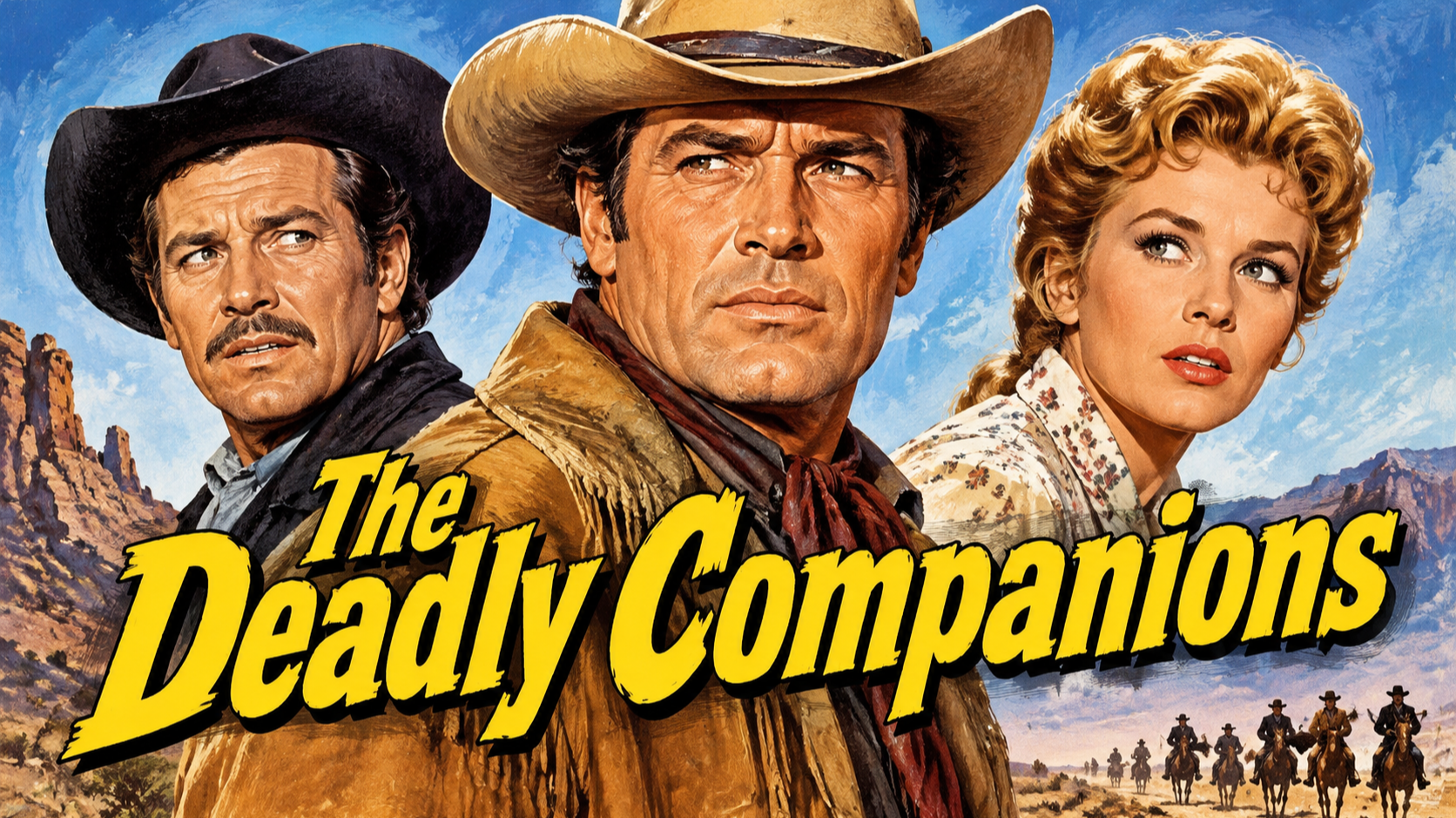
The Deadly Companions is an American Western film directed by Sam Peckinpah in his feature-film directorial debut. The film stars Maureen O’Hara, Brian Keith, Steve Cochran, and Chill Wills, and was produced by Charles B. Fitzsimons for Carousel Productions.
Set in the late 1860s, the story follows a former Union Army sergeant who accidentally kills a young boy during a gun battle. Overcome with remorse, he accompanies the boy’s mother on a dangerous journey across Apache territory so that her son can be buried beside his father. Along the way, old grudges, jealousy, and the threat of violence complicate their journey.
PLOT (Spoiler Alert)
Former Union Army sergeant Yellowleg is searching for Turk, a Confederate deserter who attempted to scalp him after finding him wounded on a battlefield during the Civil War. Yellowleg eventually locates Turk in a border-town saloon and persuades him and his quick-tempered companion, Billy Keplinger, to join him in robbing a bank in Gila City, Arizona.
When they arrive, however, another group of outlaws is already causing trouble. During the resulting gun battle, Yellowleg accidentally shoots and kills the nine-year-old son of Kit Tilden, a widowed dance-hall hostess. Grief-stricken, Kit decides to take her son's body to the abandoned town of Siringo, where her husband is buried. Feeling responsible, Yellowleg insists on accompanying her, bringing Turk and Billy along.
The journey across the dangerous desert is filled with tension. Billy attempts to assault Kit, prompting Yellowleg to throw him out of the group, while Turk eventually abandons them. Yellowleg and Kit gradually develop a bond, although he continues to conceal his personal history with Turk. After reaching Siringo, they discover that Turk and Billy have returned following a successful bank robbery in Gila City.
Yellowleg finally confronts Turk, intending to avenge the earlier attempt on his life, but a shoulder injury causes him to miss his shot. Billy fires at Turk, wounding him, but Turk manages to turn on his former companion and kill him.
A posse arrives and takes Turk back to Gila City to face justice. With the immediate danger over, Kit and Yellowleg ride away together, having formed an unexpected connection through their shared suffering.
PRODUCTION
The film was directed by Sam Peckinpah, who had previously established himself as a television director through series such as The Westerner. The screenplay was written by Albert Sidney Fleischman, based on his novel Yellowleg, published in 1960. The production was independently financed and produced by Charles B. Fitzsimons, the brother of leading actress Maureen O'Hara.
Filming began in January 1961 in and around Tucson, Arizona, including the Old Tucson movie location. William H. Clothier served as cinematographer, Stanley E. Rabjohn handled editing, and Marlin Skiles composed the music. The film was shot in Pathé Color and presented in widescreen.
RELEASE
The Deadly Companions premiered in Tucson, Arizona, on June 6, 1961, and opened in Los Angeles the following day. It was distributed in the United States by Pathé-America and runs approximately 90 minutes.
The film performed poorly at the box office and remains one of Peckinpah's lesser-known works. In 1963, it was reissued under the alternate title Trigger Happy.
CAST
Maureen O'Hara as Kit Tilden
Brian Keith as Yellowleg
Steve Cochran as Billy Keplinger
Chill Wills as Turk
Strother Martin as Parson
Will Wright as Doctor Acton
Jim O'Hara as Cal
Peter O'Crotty as the Mayor of Gila City
Billy Vaughan as Mead Tilden Jr.
Robert Sheldon as a gambler
John Hamilton as a gambler
Hank Gobble as the bartender
Buck Sharpe as an Apache
CREW
Director: Sam Peckinpah
Producer: Charles B. Fitzsimons
Screenplay: Albert Sidney Fleischman
Based on: Yellowleg, the novel by Albert Sidney Fleischman
Cinematography: William H. Clothier
Film Editing: Stanley E. Rabjohn
Music: Marlin Skiles
Music Conductor: Raoul Kraushaar
Sound: Gordon Sawyer and Robert J. Callen
Costume Design: Frank Beetson Sr. and Sheila O'Brian
Makeup: James Barker
Production Company: Carousel Productions
Distributor: Pathé-America
IMDb RATING
6.0/10 (IMDb rating at the time of research; ratings may change).
TRIVIA
Sam Peckinpah's feature-film debut: The film marked the beginning of Peckinpah's career as a theatrical feature director. He would later become famous for Westerns such as Ride the High Country (1962) and The Wild Bunch (1969).
Maureen O'Hara helped get the film made: She joined her brother Charles B. Fitzsimons and writer Albert Sidney Fleischman in forming Carousel Productions to bring the project to the screen.
Brian Keith recommended Peckinpah: Having worked with him on the television series The Westerner, Keith suggested him for the director's position.
Based on a novel: The screenplay was adapted from Albert Sidney Fleischman's novel Yellowleg, published in 1960.
An alternate title: The film was reissued in 1963 under the title Trigger Happy.
Filmed in Arizona: Locations included Old Tucson, the Sonoran Desert, and the surrounding Arizona landscape.
A family connection: Jim O'Hara, Maureen O'Hara's brother, appears as Cal, the general-store employee.
A modest production: The film was made independently by Carousel Productions rather than by one of the major Hollywood studios.
A troubled working relationship: Maureen O'Hara later expressed strong criticism of Peckinpah's directing in her autobiography, 'Tis Herself.
An early glimpse of Peckinpah's style: Although less violent and ambitious than his later Westerns, the film contains themes of revenge, moral conflict, and damaged characters that would become familiar features of his work.
WHAT OUR MOVIE REVIEWERS SAY...

The Deadly Companions is a gritty and atmospheric Western that benefits from strong performances and a compelling story of guilt, revenge, and redemption. Brian Keith and Maureen O'Hara bring depth to their characters, while Sam Peckinpah's direction gives the film a rugged visual style and an unmistakable sense of tension.

The Deadly Companions is a deliberately paced Western that places greater emphasis on character conflict than traditional gunfights. Although the story occasionally feels uneven, its performances and thoughtful exploration of personal responsibility give it more substance than the average frontier adventure.

The Deadly Companions never quite finds its footing as either a Western adventure or a character drama. The pacing is sluggish, the central journey becomes repetitive, and the characters lack the development needed to make their emotional struggles convincing. Its promising premise ultimately feels underwhelming.