

Enjoy Our Podcasts


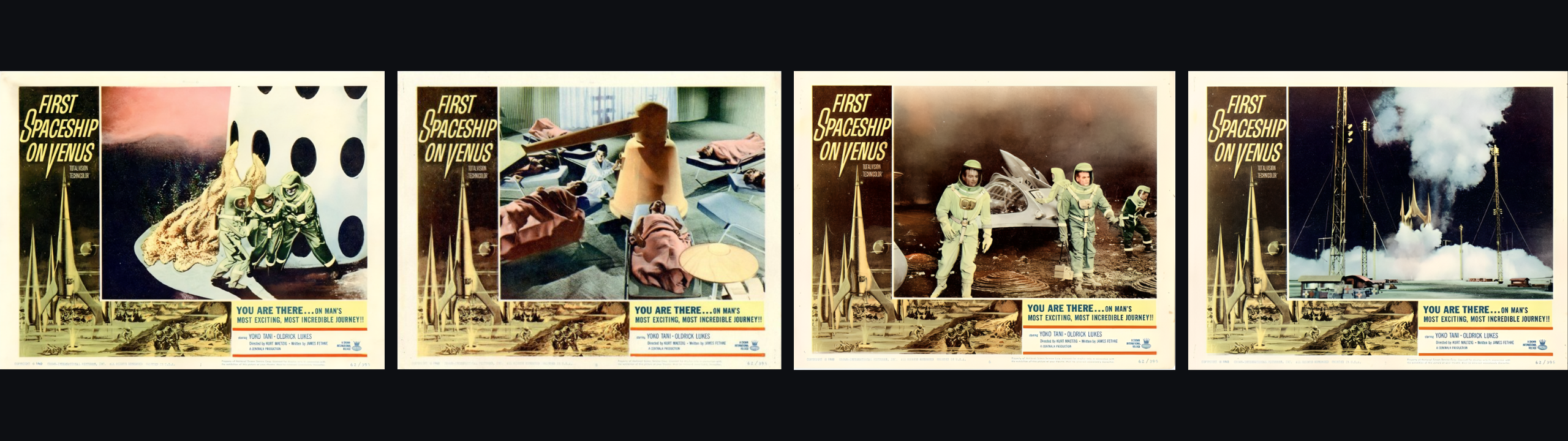
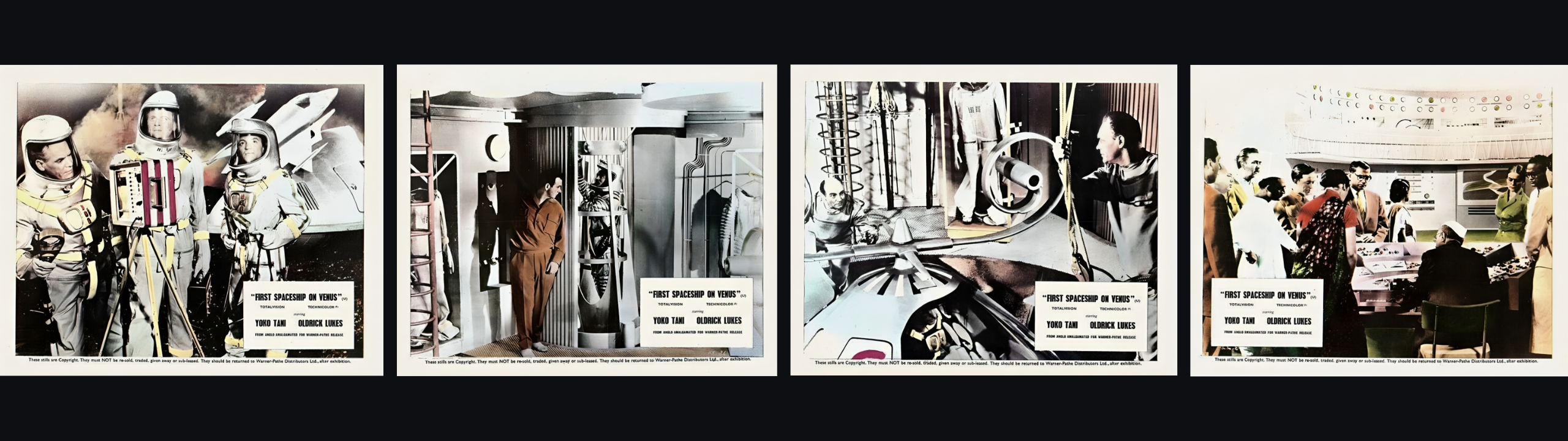
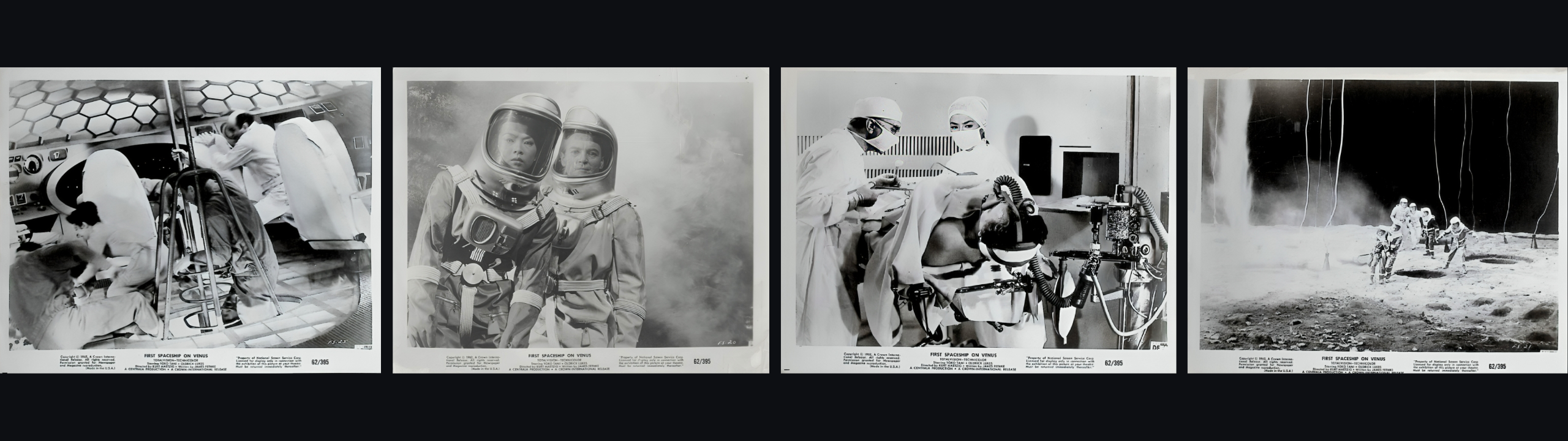
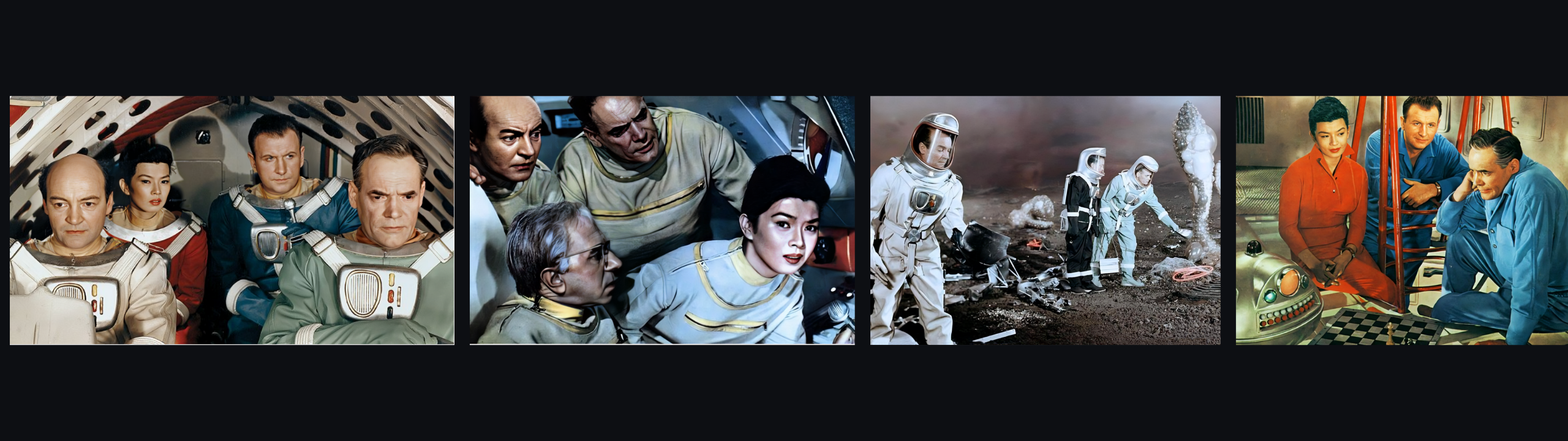
SYNOPSIS:
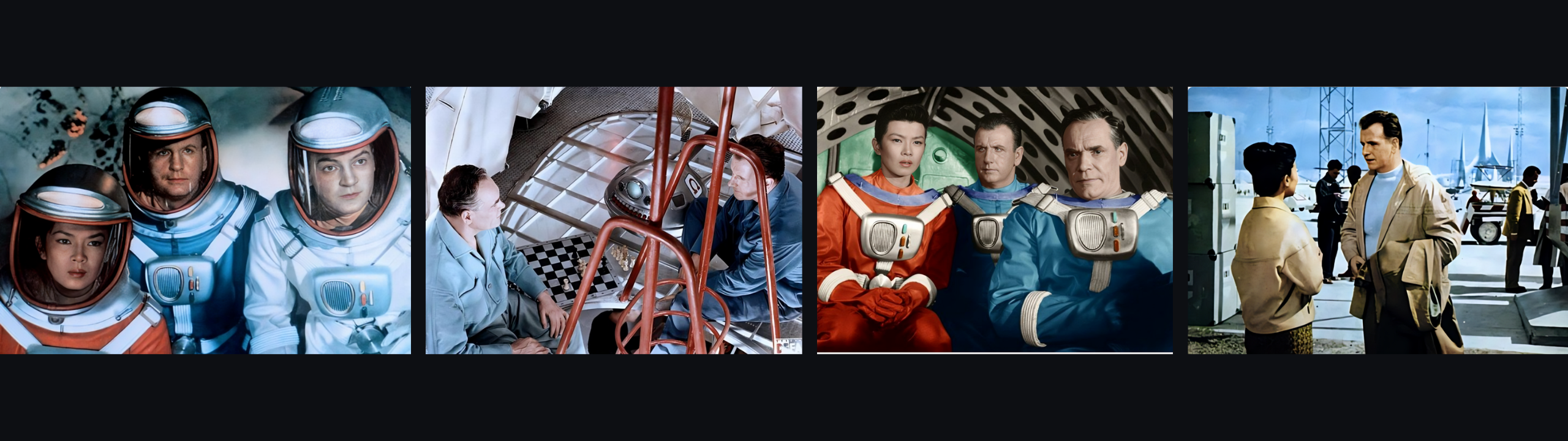
First Spaceship on Venus is a 1960 East German-Polish science fiction adventure directed by Kurt Maetzig and written by Jan Fethke and Kurt Maetzig, based on Stanisław Lem's 1951 novel The Astronauts. Starring Yoko Tani, Oldřich Lukes, Ignacy Machowski, Juliusz McLachlan, and Aribert Wäscher, the film blends science fiction, mystery, and Cold War-era speculation into an ambitious story of space exploration and international cooperation. One of the earliest large-scale European science fiction productions, it is celebrated for its imaginative visual effects, futuristic production design, and optimistic vision of humanity's future beyond Earth.
The story follows an international team of scientists and astronauts who are selected to lead mankind's first expedition to Venus after the discovery of a mysterious extraterrestrial artifact buried in the Gobi Desert. When researchers decipher the ancient object, they uncover evidence suggesting that an advanced Venusian civilization once planned an invasion of Earth. Determined to learn the truth before history is forgotten, the multinational crew embarks on a perilous journey across the solar system, where they encounter the haunting remains of a once-great civilization and begin to unravel the mystery behind its sudden disappearance.
Featuring elaborate miniature effects, imaginative spacecraft designs, and ambitious futuristic sets, First Spaceship on Venus stands as a landmark achievement in early European science fiction cinema. The film's themes of peaceful international collaboration, scientific discovery, and the destructive consequences of militarism reflect the optimism and anxieties of the early Space Age. More than six decades after its release, it continues to be admired for its visual ambition, thoughtful storytelling, and enduring influence on the science fiction genre.
PLOT (Spoiler Alert):
In the near future, scientists excavating the Gobi Desert discover a mysterious metallic spool unlike anything created on Earth. Extensive research reveals that the object is millions of years old and contains a recorded message from an extraterrestrial civilization. After decoding the message, scientists conclude that it originated from the planet Venus and appears to describe preparations for a military expedition to Earth. Fearing that the truth about the ancient transmission could reshape humanity's understanding of its place in the universe, world leaders authorize the first manned mission to Venus.
An international crew of astronauts and scientists is assembled to undertake the historic journey aboard the spacecraft Cosmokrator I. Representing several nations, the expedition reflects a vision of peaceful global cooperation in the pursuit of scientific knowledge. As the crew travels through space, they conduct experiments, overcome technical challenges, and prepare for humanity's first encounter with another world.
Upon reaching Venus, the explorers find a hostile landscape of volcanic terrain, poisonous gases, and strange geological formations. Evidence soon suggests that the planet was once home to a highly advanced civilization possessing remarkable scientific and technological achievements. However, instead of thriving cities, the crew discovers vast ruins, abandoned machinery, and mysterious remnants of a catastrophic disaster that appears to have wiped out the entire population.
As the investigation continues, the astronauts uncover records revealing that the Venusians had developed immensely powerful weapons and intended to launch an invasion of Earth long ago. Before their plans could be carried out, their own militaristic ambitions led to global destruction. Their civilization was annihilated by the very technology they had created, leaving Venus as a lifeless monument to the dangers of war and scientific progress without moral restraint.
While exploring the ruins, the crew faces numerous dangers, including violent storms, collapsing structures, and deadly environmental hazards. Despite these obstacles, they successfully gather scientific evidence documenting the rise and fall of the Venusian civilization. Their discoveries demonstrate that intelligence and technological advancement alone cannot guarantee survival if they are not accompanied by wisdom and cooperation.
After completing their mission, the astronauts safely return to Earth with the recovered data and artifacts. The expedition's findings profoundly influence humanity's understanding of the universe, serving as both a scientific triumph and a warning about the consequences of aggression and unchecked militarism. The film concludes on an optimistic note, suggesting that international cooperation and peaceful exploration offer humanity the best path toward the future.
PRODUCTION:
First Spaceship on Venus was produced as a collaboration between DEFA Studios of East Germany and the Polish film industry during the height of the Space Age. Directed by Kurt Maetzig, the film was adapted from Stanisław Lem's novel The Astronauts, although the screenplay significantly altered the source material to emphasize international cooperation and contemporary political themes. The production represented one of the most ambitious science fiction projects undertaken in Europe during the late 1950s.
Filming took place primarily at Babelsberg Studios in East Germany, with elaborate sets, miniatures, and practical special effects used to depict spacecraft interiors and the alien landscapes of Venus.
Cinematographer Joachim Hasler employed striking black-and-white photography to enhance the futuristic atmosphere, while composer Andrzej Markowski created an orchestral score that underscored the film's sense of wonder and suspense. The impressive visual effects and production design remain among the film's most enduring achievements.
RELEASE:
First Spaceship on Venus premiered in East Germany on 11 March 1960 before receiving theatrical releases throughout Europe and later in the United States. For its American release, substantial edits were made, including new dubbing, altered character names, and the removal of several politically themed scenes in an effort to appeal to Western audiences. Despite these changes, the film attracted attention for its ambitious visual effects and imaginative depiction of interplanetary travel.
Critical reception was mixed upon release, with reviewers praising the film's impressive production design while offering differing opinions on its pacing and ideological themes. Although its commercial performance varied between international markets, First Spaceship on Venus has since earned recognition as a pioneering work of European science fiction. Modern restorations and home video releases have introduced the original version to new audiences, who continue to appreciate its historical importance and influence on later space exploration films.
CAST:
Yoko Tani as Dr. Sumiko Ogimura
Günther Simon as Deutscher Pilot/Robert/Raimund Brinkmann
Ignacy Machowski as Soltyk
Oldřich Lukes as Arseniev
Juliusz McLachlan as Brinkman
Aribert Wäscher as Professor Sikarna
Kurt Rackelmann as Astronaut
Alfred Maack as Professor Hawling
CREW:
Director: Kurt Maetzig
Producers: DEFA Studio for Feature Films
Writers: Jan Fethke, Kurt Maetzig; based on The Astronauts by Stanisław Lem
Cinematographer: Joachim Hasler
Editor: Lena Neumann
Music: Andrzej Markowski
Production Company: DEFA Studio for Feature Films (East Germany), Zespół Filmowy (Poland)
Distributor: Progress Film (East Germany)
Release Date: March 11, 1960
Country of Origin: East Germany / Poland
Running Time: 93 minutes (original version)
Budget: N/A
Box Office Return: N/A
IMDb Rating = 6.3 / 10
TRIVIA:
The film is based on Stanisław Lem's first science fiction novel, The Astronauts, published in 1951.
Lem was reportedly dissatisfied with the adaptation because it departed significantly from his original story.
It was one of the earliest large-scale science fiction co-productions between East Germany and Poland.
The spacecraft Cosmokrator I was realized through detailed miniatures and practical effects, impressive achievements for European cinema of the period.
The original European version differs substantially from the American release, which was shortened, re-dubbed, and re-edited.
Actress Yoko Tani, who portrayed Dr. Sumiko Ogimura, was a Japanese-French actress known for appearing in several international science fiction and adventure films.
The film reflects Cold War ideals of peaceful international cooperation by depicting a multinational crew working together rather than competing in the Space Race.
Much of the futuristic production design was inspired by contemporary scientific concepts and early space exploration research of the 1950s.
The Venusian civilization serves as a cautionary allegory about the destructive consequences of militarism and nuclear warfare.
The film's imaginative visual effects and ambitious world-building influenced later European science fiction productions during the 1960s.
Modern critics regard First Spaceship on Venus as an important milestone in Eastern European science fiction cinema and one of the most visually ambitious genre films produced before the space missions of the late 1960s.
In the US, this was distributed in an edited and English- dubbed version as "First Spaceship on Venus" through Crown International. It was at the top of a prepackaged double feature with Varan the Unbelievable (1962). It became Crown's most successful double feature since, unlike other Crown releases, it was booked into many theaters as well as drive-ins.
Based on Stanislaw Lem's 1951 novel "Astronauci" ("The Astronauts"). This was his first novel and, to get it published, he had to insert some pro-communist elements. These contributed to the government's approval for this expensive and high-profile production by DEFA. The communist elements were minimized in the film.
Meant to be a high-profile release by DEFA for the tenth anniversary of the German Democratic Republic (East Germany).
The German version contains a reference to one of the professors having his career stalled when he was thrown out of the university by the Nazis. Director and co-writer Kurt Maetzig had his career stalled by the Nazis because his mother was Jewish.
The writing process involved three writing teams and 12 screenplays before a final script was acceptable to the studio and the government.

OUR MOVIE REVIEWERS SAY...

"First Spaceship on Venus is an imaginative science fiction adventure that combines Cold War-era optimism with genuine mystery. Its ambitious visual effects and thought-provoking themes make it one of the most underrated space films of its generation."

"First Spaceship on Venus is more interesting for its ideas than its execution. Although the pacing is deliberate and the dialogue occasionally stiff, its vision of international cooperation and extraterrestrial discovery gives the film lasting appeal."

"Despite an intriguing premise, First Spaceship on Venus struggles with uneven pacing and wooden performances. The impressive production design can't quite overcome a story that spends too much time explaining its mysteries instead of letting them unfold naturally."