
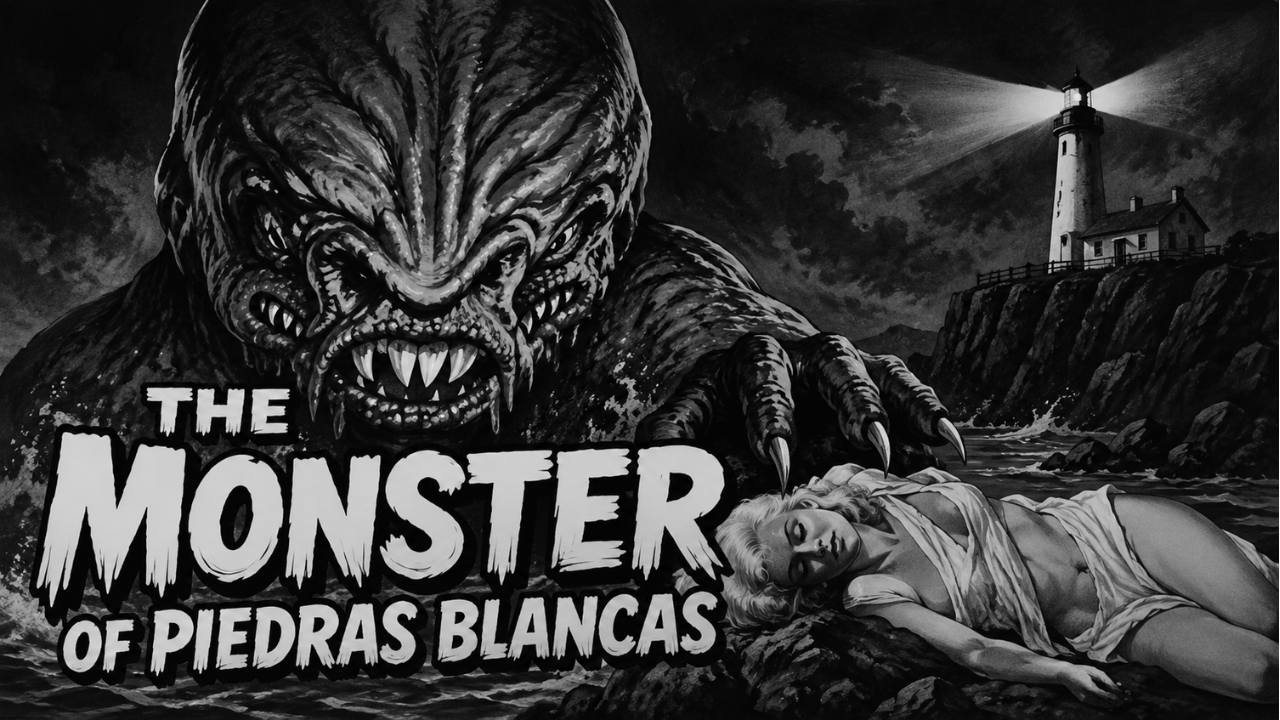
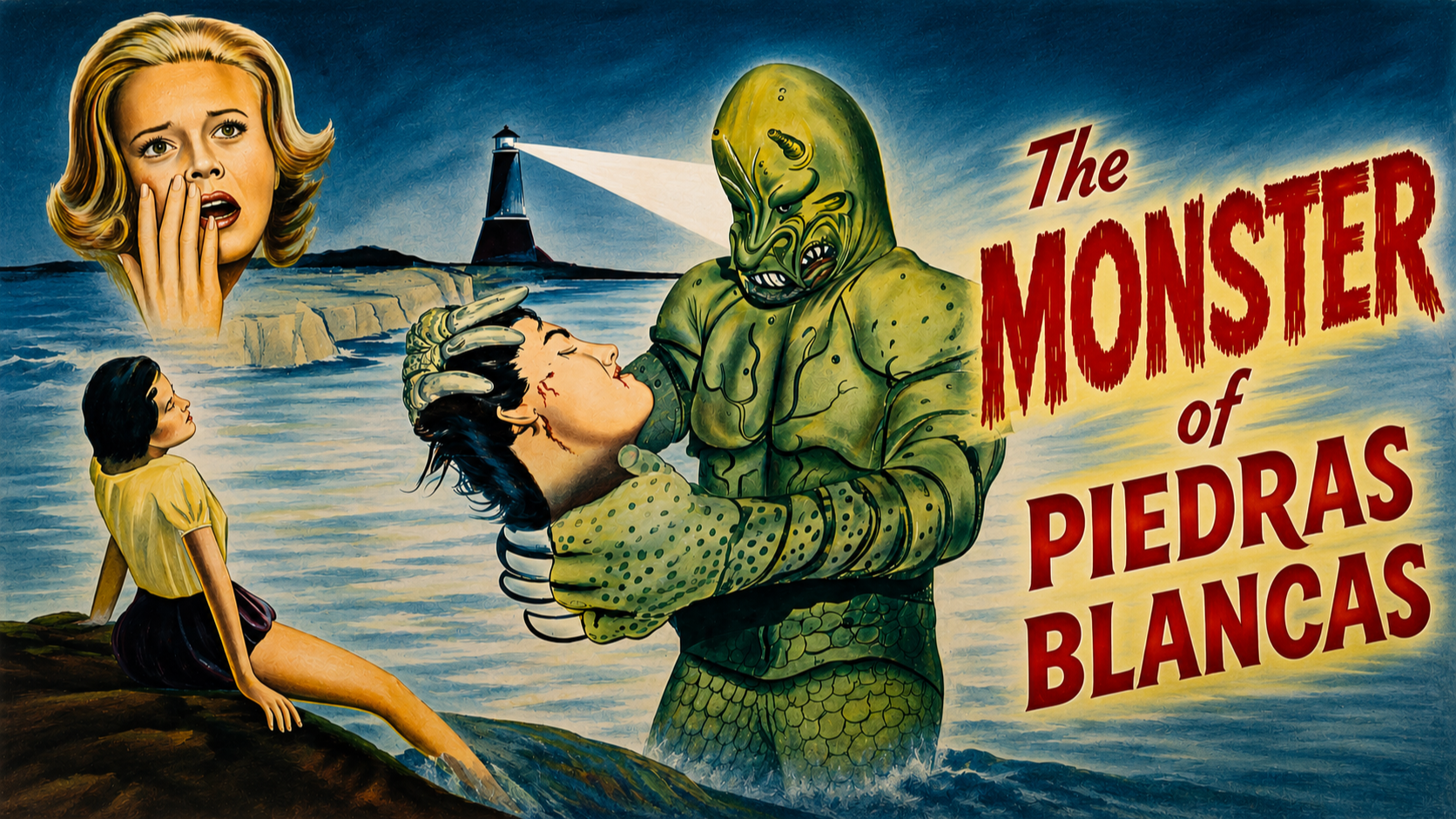
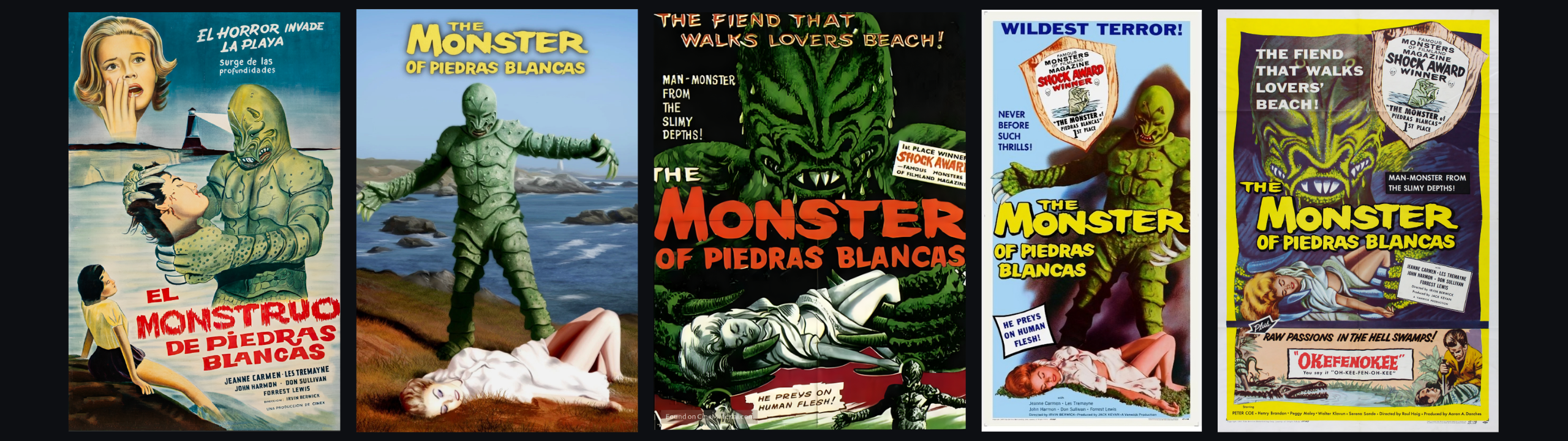
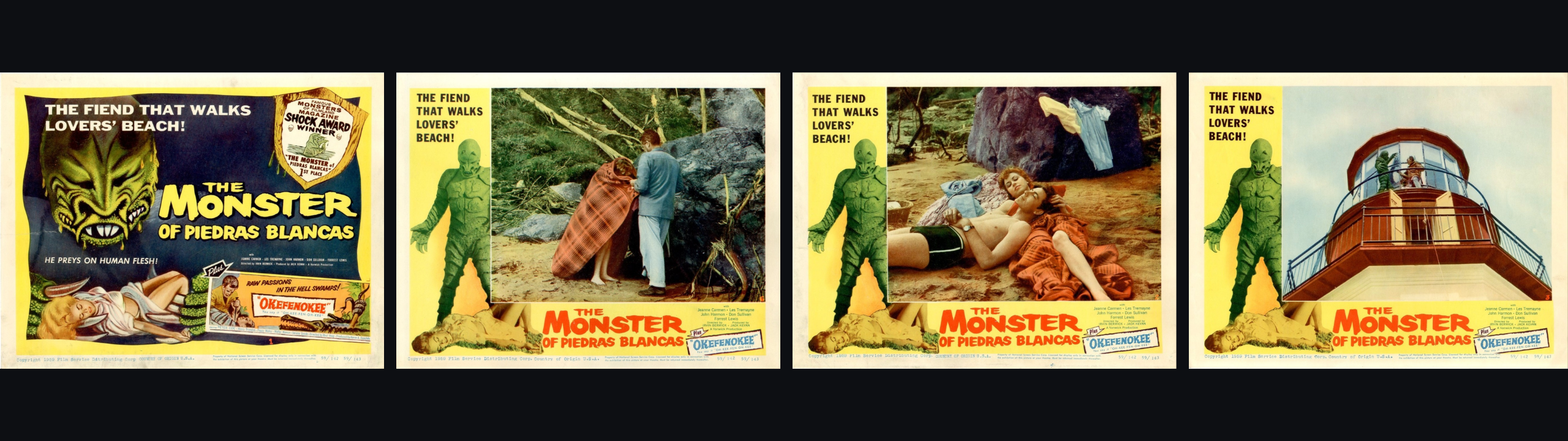
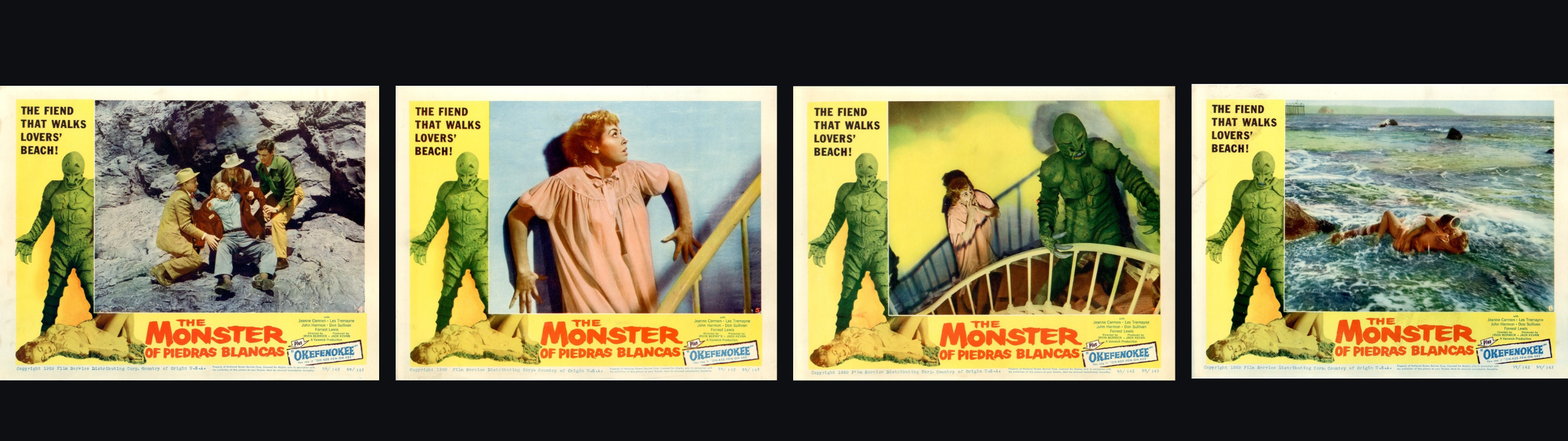

SYNOPSIS: "The Monster of Piedras Blancas" (1959) is a classic low-budget horror film directed by Irvin Berwick that combines small-town suspense with creature-feature thrills. Set in the isolated coastal community of Piedras Blancas, the story centers on a series of gruesome murders that begin to terrorize local residents. The mysterious deaths appear connected to an ancient sea creature that lurks among the rocky shoreline and fog-shrouded waters near the town's lighthouse.
The creature is secretly being fed by Sturges (played by John Harmon), the aging lighthouse keeper who has developed a strange attachment to the monstrous being over many years. As the body count rises, suspicion spreads throughout the community, and the townspeople struggle to understand the source of the horrifying attacks.
Sheriff George Mathews (played by Forrest Lewis) and local scientist Dr. Jorgensen (played by Les Tremayne) investigate the killings while trying to protect the town from an increasingly dangerous threat.
As tensions mount, the monster becomes more aggressive and difficult to control. The film builds toward a suspenseful confrontation between the creature and the townspeople, blending atmospheric horror with elements of science fiction and traditional monster-movie storytelling. Remembered for its striking creature design and eerie seaside setting, "The Monster of Piedras Blancas" remains a cult favorite among fans of 1950s horror cinema.
PLOT Spoiler Alert: "The Monster of Piedras Blancas" (1959) begins in the quiet California coastal village of Piedras Blancas, where fishermen and residents begin disappearing under mysterious circumstances. The victims are discovered brutally decapitated, leaving the local authorities baffled and frightened. Unknown to the townspeople, the murders are being committed by a grotesque amphibious sea creature that inhabits a cave near the shoreline.
The monster survives thanks to the efforts of lighthouse keeper Sturges, who regularly provides food for the creature. Over time, Sturges has come to regard the monster almost as a pet, believing he can keep it under control. However, the creature's appetite continues to grow, forcing it to seek prey beyond the food Sturges can provide.
As more killings occur, Sheriff George Mathews launches an investigation. Meanwhile, Lucy Marden (played by Jeanne Carmen), the daughter of local scientist Dr. Jorgensen, becomes increasingly concerned by the strange events unfolding around the town. Evidence gradually points toward the coastline and the lighthouse, bringing the authorities closer to the horrifying truth.
Eventually, the monster begins attacking more openly, exposing its existence to the townspeople. Sturges realizes too late that he can no longer control the creature he has protected for so many years. In a tragic turn of events, the monster kills Sturges before rampaging through the area in search of food.
The film reaches its climax when an armed posse confronts the creature near its coastal lair. After a tense pursuit and violent struggle, the monster is shot repeatedly and killed. With the creature destroyed, peace returns to Piedras Blancas, though the community is left haunted by the terrifying events that unfolded along its rocky shores.
"The Monster of Piedras Blancas" remains a memorable entry in the wave of independent monster movies that flourished during the 1950s, combining suspense, tragedy, and creature-feature excitement into a compact horror tale.
PRODUCTION: "The Monster of Piedras Blancas" (1959) was produced by Jack Kevan and Irvin Berwick and directed by Berwick. The film was made during the height of America's fascination with science-fiction and horror movies, a period that saw numerous independent productions featuring strange creatures and supernatural threats.
Production took place primarily along the California coastline, where natural rocky landscapes provided an atmospheric setting for the story. The filmmakers worked with a modest budget, relying on practical effects and creative cinematography to create suspense rather than elaborate special effects. Much of the film's effectiveness comes from its use of fog, darkness, and the isolated seaside environment.
One of the production's most notable achievements was its creature design. The monster costume was created by Jack Kevan, who had previously worked on the creature effects for the influential science-fiction classic "Creature from the Black Lagoon" (1954). The resulting design gave the film a distinctive monster that has remained popular among horror fans.
The cast consisted largely of character actors and lesser-known performers, allowing the production to focus its resources on atmosphere and creature effects. Director Irvin Berwick emphasized mystery and tension throughout the film, creating a sense of dread that builds steadily as the monster's attacks increase.
Overall, "The Monster of Piedras Blancas" exemplifies the ingenuity of independent horror filmmaking during the 1950s, achieving memorable results despite its limited budget and resources.
RELEASE: "The Monster of Piedras Blancas" (1959) was released in the United States by Film Classics, Inc. in July 1959. Arriving near the end of the decade that popularized giant monsters, alien invaders, and mutated creatures, the film sought to capitalize on audiences' continued appetite for horror and science-fiction entertainment.
The film received modest theatrical distribution, often appearing as part of double-feature programs alongside other genre pictures. While reviews at the time were mixed, many critics praised the creature makeup and atmospheric coastal setting, even as they noted the film's limited budget.
Although it was not a major commercial success, "The Monster of Piedras Blancas" gradually developed a loyal following among fans of classic horror cinema. Television broadcasts in subsequent decades introduced the film to new audiences, helping establish its reputation as a cult favorite.
Today, the film is remembered primarily for its impressive monster design, effective atmosphere, and its connection to the legacy of 1950s American creature features. It continues to be appreciated by genre enthusiasts as an entertaining example of independent horror filmmaking from the era.
CAST:
Les Tremayne as Dr. Jorgensen
John Harmon as Sturges
Jeanne Carmen as Lucy Marden
Forrest Lewis as Sheriff George Mathews
Don Sullivan as Fred Collins
Richard H. Cutting as Tom Kincaid
Frank Arvidson as Constable Jones
Ruth Lee as Mrs. Mathews
CREW:
Director: Irvin Berwick
Producers: Irvin Berwick, Jack Kevan
Writer: H. Haile Chace
Cinematographer: Philip Lathrop
Editor: Merrill G. White
Music: Albert Glasser
Production Company: Vanwick Productions
Distributor: Film Classics, Inc.
Release Date: July 1959
Country of Origin: United States
Running Time: 71 minutes
Budget: Approximately $29,000
Box Office Return: Modest theatrical earnings
IMDB Rating = 5.4 / 10
TRIVIA:
The monster costume was designed by Jack Kevan, who also contributed to the creature effects for "Creature from the Black Lagoon" (1954).
The film was shot on a very small budget but has earned a strong cult following among classic horror fans.
Many exterior scenes were filmed along the California coast, providing an authentic and atmospheric backdrop.
The creature's design is often praised as one of the film's strongest elements despite the limited resources available.
The lighthouse featured prominently in the story became one of the film's most recognizable visual elements.
The movie's graphic decapitation murders were unusually shocking for a low-budget horror film of the late 1950s.
Actor John Harmon delivers one of the film's most memorable performances as the sympathetic yet misguided lighthouse keeper Sturges.
The film blends elements of classic Universal monster movies with the science-fiction creature features popular during the 1950s.
Television broadcasts during the 1960s and 1970s helped introduce the movie to a wider audience and contributed to its cult status.
The creature is never given a specific scientific name, adding to its mystery and otherworldly nature.
"The Monster of Piedras Blancas" remains a beloved cult horror film known for its atmospheric seaside setting, tragic storyline, and memorable monster design.
The feet and lower torso of the Monster suit were were recycled from the "Metaluna Mutant" in This Island Earth (1955), with the claws being recycled from the creatures in The Mole People (1956).
Piedras Blancas (Spanish for "White Rocks") actually exists. It's a promontory on the central California coast and it does have a lighthouse that was used in this film, but only for exterior shots.
The exterior and interior lighthouse location used in the film is the Point Conception Lighthouse in California. The same location was used in Brave New World (1980).
Jimmy, the little boy, is played by Wayne Berwick, son of the director.
In 1965 the monster costume for this film was used in Flipper's Monster (1965), in which film crew is shooting a "monster movie" in Florida. That episode was directed by Ricou Browning, the show's creator, who coincidentally was best known for playing the "Gill-Man" in Creature from the Black Lagoon (1954), which was the inspiration for "Monster of Piedras Blancas".
OUR MOVIE REVIEWERS SAY...

"The Monster of Piedras Blancas" (1959) is exactly the kind of low-budget horror gem that rewards viewers willing to look beyond its modest production values. What the film lacks in spectacle, it more than makes up for with atmosphere. The fog-covered coastline, lonely lighthouse, and eerie sense of isolation create a genuinely unsettling mood that many larger productions fail to achieve. John Harmon gives an unexpectedly poignant performance as Sturges, lending emotional weight to what could have been a routine monster movie.

"The Monster of Piedras Blancas" (1959) occupies an interesting middle ground among 1950s horror films. It features a striking monster design and an atmospheric coastal setting that give it a distinct personality, but the story itself follows a fairly familiar creature-feature formula. The performances are competent, though the pacing occasionally slows during the investigative scenes. While the film never rises to the level of the genre's classics, it remains a respectable and entertaining example of independent horror filmmaking from the era.

The Monster of Piedras Blancas" (1959) has an intriguing premise and a surprisingly effective monster costume, but neither is enough to overcome the film's many shortcomings. The narrative unfolds at a sluggish pace, and much of the suspense is undermined by repetitive scenes and underdeveloped characters. Despite the atmospheric seaside locations, the production often feels constrained by its limited budget, resulting in a film that never fully capitalizes on its potential. Horror fans may appreciate the creature itself, but for general audiences, the experience is likely to feel more quaint than frightening.